What Is Mental Arithmetic? A Complete Guide for Parents
Many parents have heard the words "mental arithmetic" by now: ads show a five-year-old adding three-digit numbers in seconds. But what is it really — a miracle, a marketing trick, or a genuinely useful practice? In this article we explain honestly and clearly what mental arithmetic is, how it works, what real benefits it brings a child, and how to get started.
What exactly is mental arithmetic?
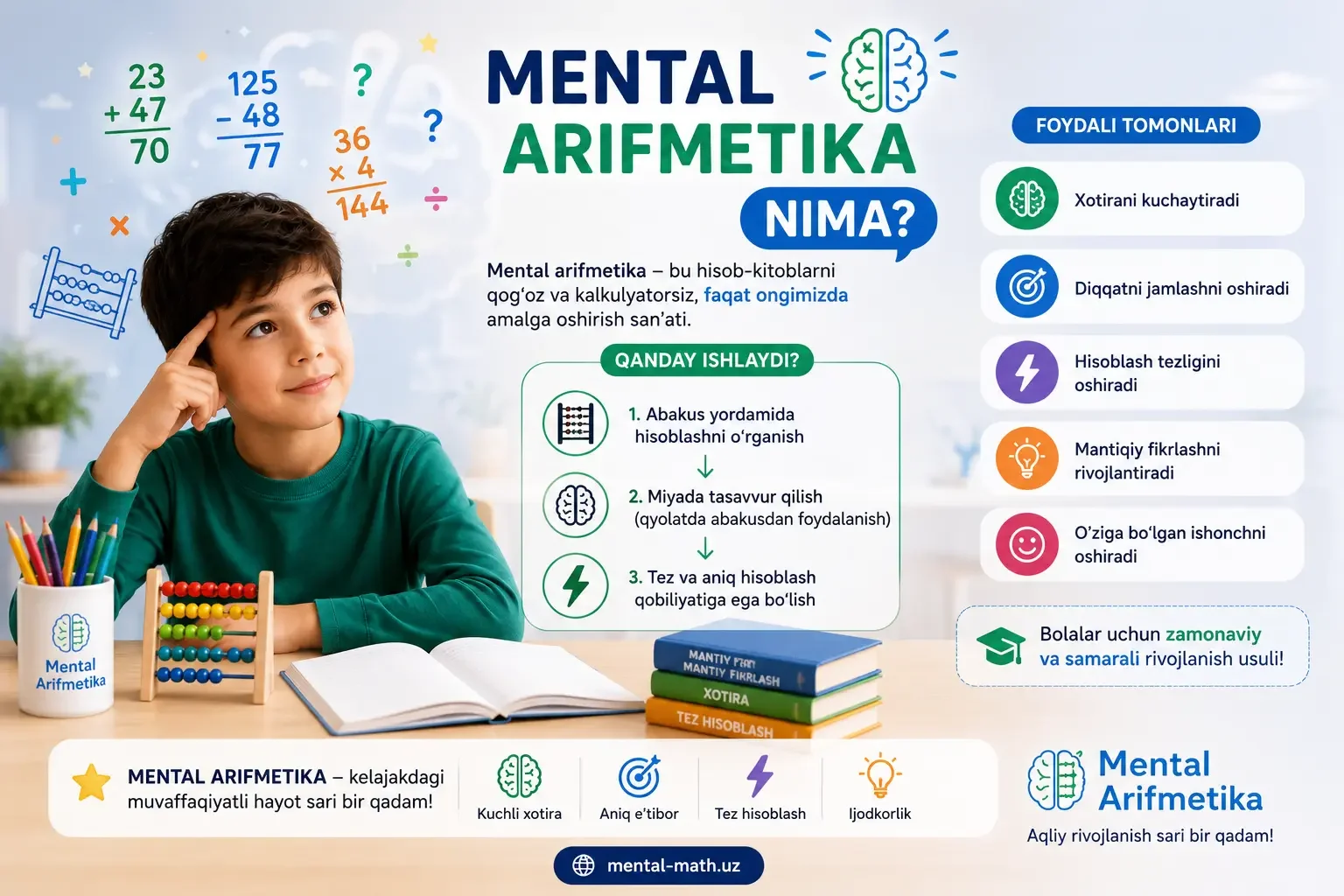
Mental arithmetic is the skill of performing operations with numbers without paper, a calculator or fingers — entirely in the head — and the teaching method built around that skill. At its core lies an ancient counting tool: the abacus (soroban in its Japanese form). The child first learns to calculate by sliding beads on a real abacus; then the tool is taken away, and the child performs the same movements on an imaginary abacus — in their mind. As a result, they see numbers not as digits but as images, and calculate noticeably faster.
How it works: from the abacus to calculating in the head
Learning usually unfolds in three stages:
- The real abacus. The child learns what the beads mean and how to move them for addition and subtraction. Fine motor skills and visual memory work actively at this stage. You can explore the starting concepts on the abacus basics page.
- The imaginary abacus. The tool is gradually removed, and the child "slides" the beads in their imagination. This is where the essence of mental arithmetic begins.
- Automation. With regular practice the imagined movements speed up, and calculation becomes almost reflexive.
Why does this work? Ordinary calculation relies mostly on logic, while working with an imaginary abacus also engages imagery and spatial reasoning. In other words, logical thinking and visual imagination are trained at the same time — the brain works actively in both directions. That is a rare combination for a single activity.
What does it give a child?
Let's be honest: mental arithmetic does not turn a child into a genius. But children who practise regularly show very real changes:
- Attention. On the imaginary abacus one wrong step ruins the whole answer, so the child learns to focus fully on every move.
- Working memory. Holding intermediate results in the head trains memory like a muscle.
- Calculation speed and no fear of maths. Numbers become the child's "friends", and school maths feels easier.
- Self-confidence. The feeling of "I can work this out in my head" has a positive effect on self-esteem.
- Imagination and spatial thinking. Visualising the beads develops imagery-based thinking.
One important note: these benefits come only with regular practice. A child who trains once a week will not become a "superhero" — the real secret is 10-20 minutes of consistent daily practice.
What age can a child start?
The most favourable window is age 5 to 7: the brain absorbs new skills quickly, and the child is just beginning to understand numbers consciously. Starting at 8-10 is not too late either, and even adults can learn. We covered the readiness signs and what the first months look like in a separate article: at what age should a child start the abacus.
What methods are there?
Mental arithmetic is not a single trick — it is a whole family of methods:
- Friend of 10. Fast addition through pairs that make 10 (3+7, 4+6...). Read more on the friend of ten technique page.
- Little friends (friends of 5). Formulas for working with the upper bead of the abacus.
- Big friend. Using the friends of 10 when crossing over a ten.
- Vedic mathematics. Speed-calculation techniques from India — for example, multiplying numbers close to 100.
- The Trachtenberg system. Special rules for multiplying by 11, 12 and 9.
A good programme introduces these methods gradually, playfully, and matched to the child's level.
Myths and reality
There is a lot of exaggeration around mental arithmetic, so a balanced view matters:
- Myth: "The child will become a top student in every subject." Reality: the main gains are in calculation, attention and memory; the effect on other subjects is indirect and gradual.
- Myth: "The earlier the better — even from age 3." Reality: starting too early tires the child and kills their interest.
- Myth: "Mental arithmetic can do no harm at all." Reality: excessive pressure, competition stress and overload can hurt a child — we wrote about this openly in our article on what teachers and experts warn about.
The conclusion is simple: mental arithmetic is not a miracle, but a genuinely useful brain workout when given in the right dose and combined with play.
How to start at home or online?
Mental arithmetic used to be taught only in learning centres. Today you can start at home, online. On the MentalMath platform a child moves step by step from abacus basics to the friend of 10 and other methods — lessons are built as games and adventures (Story Mode), so the child sees practice not as a duty but as play. The starter exercises are free: you try first, and continue if your child enjoys it. As a parent, you can follow your child's results through weekly reports.
Summary
Mental arithmetic is a method that begins with the abacus, moves on to calculating in the head, and trains a child's attention, memory and self-confidence. It is not a magic wand, but with regular, game-based practice a child begins to feel at home in the world of numbers. The wisest step is to start small: 10-15 minutes a day, without pressure, with curiosity.