The Hidden Dangers of Mental Arithmetic: What Teachers and Experts Warn About
Today, mental arithmetic franchises have become so popular that most parents look at them as a "magic pill"—a super-science capable of turning any child into a genius in the shortest time possible. Others, conversely, dismiss it as a temporary gimmick with no real-world value.
But is there a darker, hidden side to this educational trend? Based on the real-world observations of experienced schoolteachers, educators, and neuropsychologists, it is time to have an honest conversation about the 7 major negative consequences and hidden dangers of mental arithmetic when taught incorrectly.
1. Excessive Workload and Fast Burnout (Mental Exhaustion)
In pursuit of quick marketing results, many learning centers force children to solve hundreds or thousands of identical, mechanical equations on worksheets or screens. Due to their age and desire to please their parents, children never say "no" and work to the point of exhaustion.
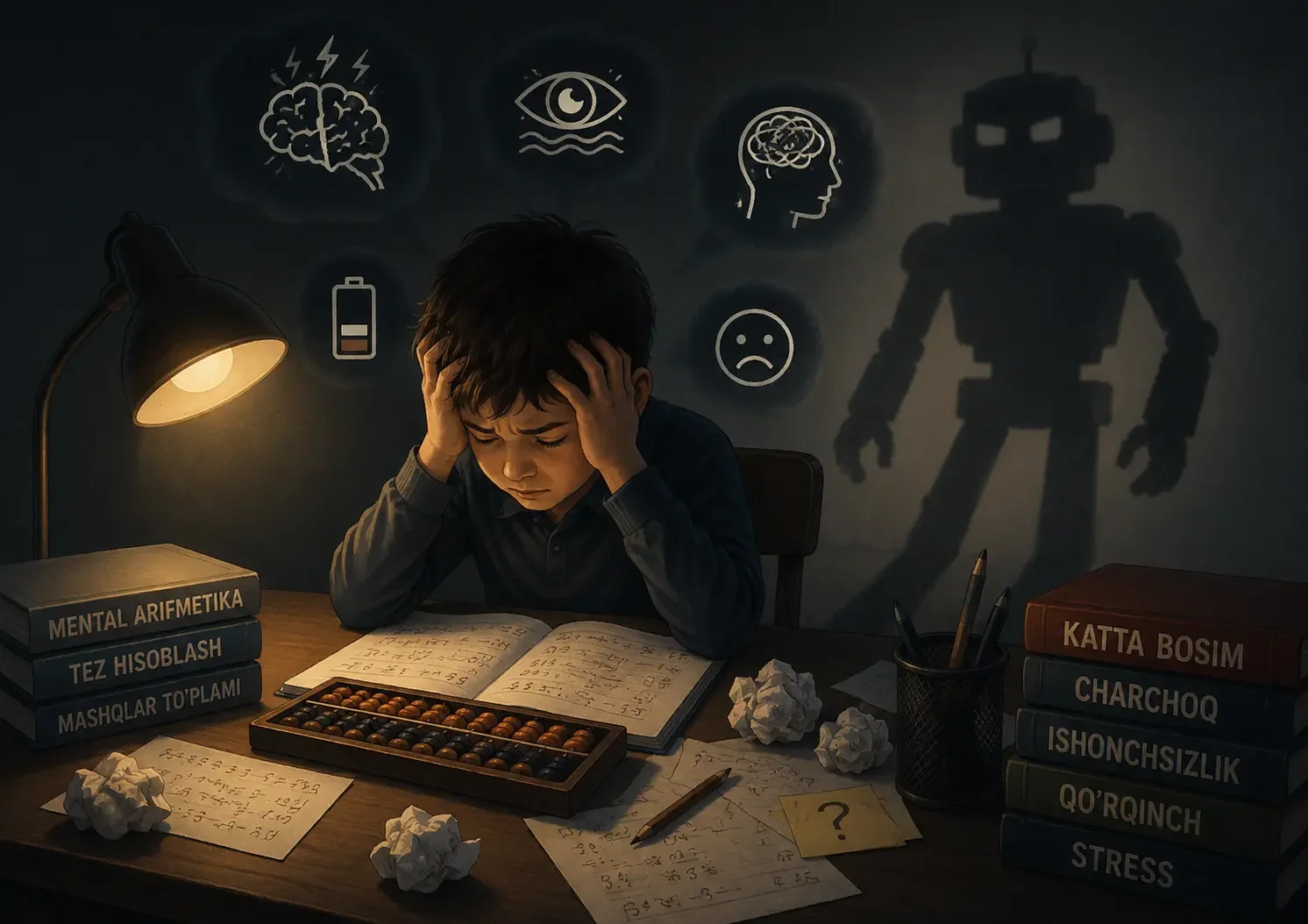
However, when cognitive load exceeds healthy limits, the brain switches into a defensive mode. Spending hours in classrooms combined with heavy weekly workloads triggers what science calls "Sensory Overload." Consequently, the child completely burns out, becomes apathetic, irritable, or aggressive, and develops a deep resentment toward mathematics and learning as a whole.
2. Carelessness and Chronic Rushing Syndrome
The vast majority of mental arithmetic programs demand only one thing from a child: deliver the answer as quickly as possible, literally within fractions of a second.
This constant rush conditions the child's personality into a state of chronic impulsivity. The brain learns to scan everything superficially just to get rid of the task quickly. As a result, in everyday life and standard school lessons, the child becomes restless—failing to listen to instructions, skipping text lines, trying to guess answers instantly, and making careless mistakes in simple tasks due to a total lack of sustained focus.
3. Refusing to Write in Notebooks and the Trap of Illusionary Confidence
Once they master fast mental calculations, children eventually completely refuse to write in notebooks. They fall into a psychological trap: "I can calculate everything in my head anyway, so why waste time writing it down?"
However, this shortcut has its limits. Upon entering higher grades, students face complex algebraic equations, geometric proofs, and multi-step physics and chemistry formulas that are physically impossible to solve without systematic documentation on paper. A child who has abandoned the culture of structured writing and written literacy inevitably begins to fail in the core school curriculum.
4. Impatience and Irritability in Creative Tasks
Writing essays, drawing, designing, or solving abstract, open-ended problems are processes that inherently require time, patience, and deep reflection.
A brain conditioned by mental math to receive validation in milliseconds experiences extreme stress and impatience when facing long, creative tasks. The child cannot sit still, gets easily frustrated, abandons projects halfway through, and actively avoids any activity that demands prolonged, thoughtful labor.
5. Acceleration of Mechanical Calculation and Halting of Logical Finking
One of the most alarming phenomena observed by educators is a child who adds and subtracts multi-digit numbers with the speed of a computer, yet completely freezes when given a simple logical word problem.
Why does this happen? Because the training was reduced to the blind memorization of formulas. While the calculation zone of the brain accelerated, analytical thinking and strategic analysis remained completely stagnant. As schoolteachers point out, in many traditional centers, children are not turned into brilliant mathematicians, but rather into "counting robots."
6. Artificial Competitions and Severe Social Pressure
Most modern mental arithmetic olympiads and tournaments are purely commercial, designed for corporate promotion while damaging children's fragile mental health.
Placing demands like: "You must achieve 100% accuracy, and you have no right to fail or slow down by even a millisecond!" builds intense social pressure. Children who fail to win trophies or make a single mistake under the weight of these expectations end up feeling like failures. This leads to severe anxiety, neurosis, loss of self-esteem, and childhood depression.
7. Disconnection from School Subjects (Lack of Integration)
When mental arithmetic is taught in isolation from real-world applications and other sciences, the child gets trapped in a dry world of abstract digits.
Without proper interdisciplinary integration, a child's performance in critical subjects like native language, literature, natural sciences, and history begins to rapidly decline. The child becomes awkward and incompetent in holistic studies because their brain is trained to process information solely through numerical codes, completely ignoring context and deeper meanings.
Conclusion
As you can see, the anxieties shared by teachers and neuropsychologists are entirely valid. Mental arithmetic built on rigid mechanical templates, social pressure, and excessive workloads can cause serious harm to your child's intellect and psychological well-being.
The first step to a solution is recognizing and admitting the problem exists.
But how can you protect your child from these 7 dangerous traps? How should mental arithmetic be structured so that it fosters flexible logic instead of turning a child into an impulsive machine?
We will discuss this in deep detail in our next article. Stay tuned!
For the full picture of the method, its benefits and the best starting age, read our guide What is mental arithmetic?.