At what age should a child start learning the abacus (soroban)?
Many parents aren't sure when to introduce their child to mental arithmetic. The truth is there is a sweet spot for starting the abacus (soroban) — let's look at it in detail.
The recommended age: 5 to 7
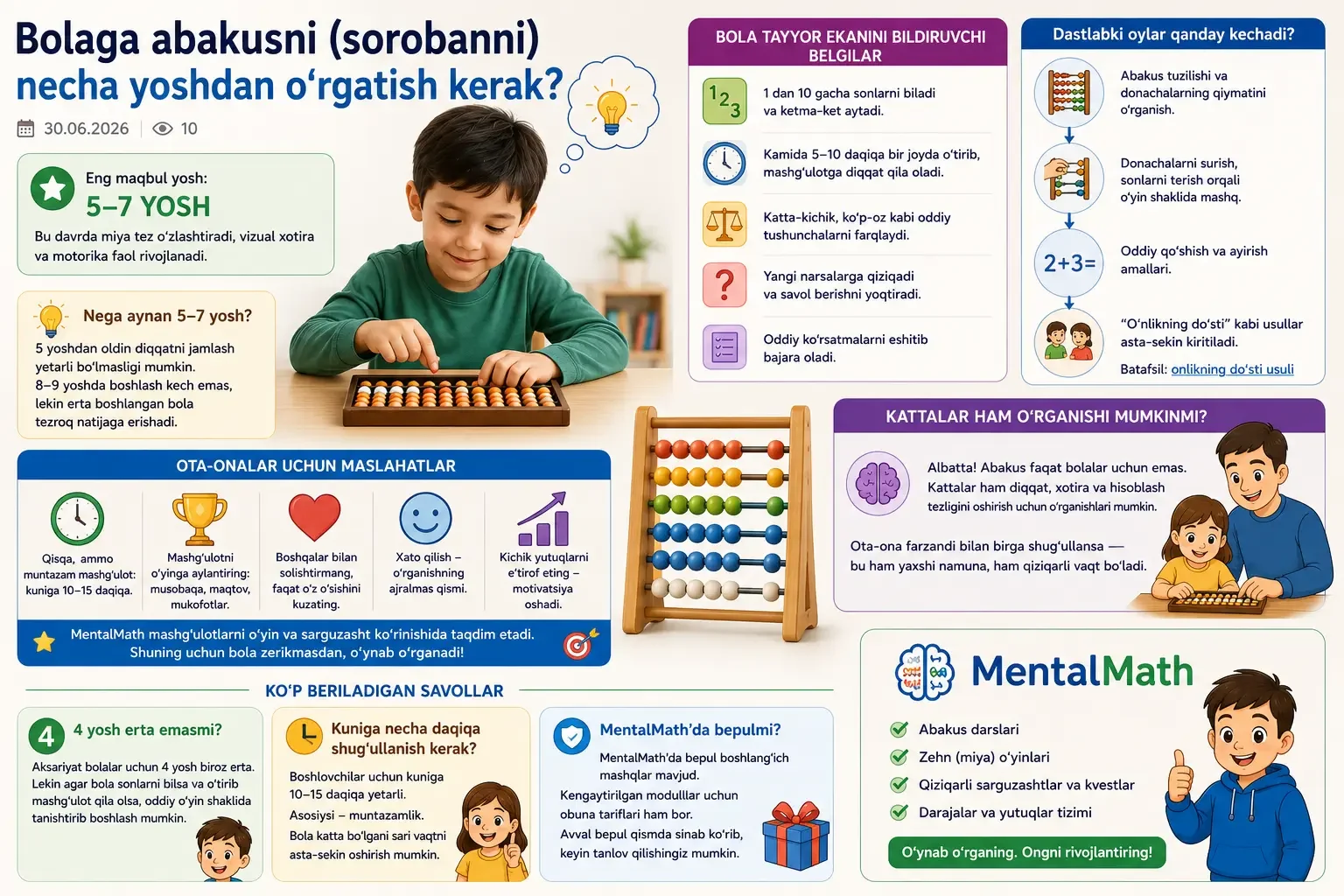
The most favourable age to begin mental arithmetic is between 5 and 7. During this period a child's brain absorbs new skills remarkably fast, and visual memory and fine motor control develop actively. The child is just beginning to understand numbers consciously, and the abacus lets them learn through both hands and eyes at once. Before 5, most children struggle to hold their attention; at 8-9 it is not too late to start, but children who begin earlier usually reach results faster.
Signs your child is ready
Age alone isn't enough — watch for your child's inner readiness too. These are good signs:
- knows the numbers 1 to 10 and can count them in order;
- can sit still and stay focused on an activity for at least 5-10 minutes;
- understands simple concepts like more-less and big-small;
- shows curiosity about new things and enjoys asking questions;
- can listen to and follow simple instructions.
If your child doesn't recognise numbers yet, you can build the foundation playfully by getting to know the basics of the abacus.
What the first months look like
In the first months the child learns how the abacus is built — the upper and lower beads and what they represent. Lessons take the form of play: sliding beads, setting numbers, simple addition and subtraction. What matters is not speed or difficulty, but correct movements and keeping the interest alive. At this stage techniques like the "friend of ten" are introduced gradually — you can read more on the friend of ten technique page.
Tips for parents
The most important rule is short but regular practice. Ten to fifteen minutes every day works far better than one long session once a week. Turn practice into a game: little contests, praise and small rewards keep a child motivated. Don't compare your child with others — follow only their own progress. If they make a mistake, don't scold them; mistakes are part of learning too. The MentalMath platform presents lessons as games and adventures, so the child learns by playing and never gets bored.
Can adults learn too?
Absolutely. The abacus isn't just for children. Adults can also learn mental arithmetic to sharpen their focus, memory and calculation speed. Unlike children, adults need a bit more conscious repetition and patience. And when a parent practises alongside their child, it becomes both a great example and enjoyable time spent together.
Is 4 too early?
For most children 4 is a little early, because attention isn't developed enough yet. But if a child already knows numbers and can sit through an activity, you can start with a light, playful introduction.
How many minutes a day?
For beginners, 10-15 minutes a day is plenty. Consistency is what matters most. As the child grows and gains skill, you can gradually increase the time.
Is it free on MentalMath?
MentalMath offers free starter exercises, along with subscription plans for the more advanced modules. You can try the free part first and then decide.
For the full picture of the method, its benefits and the best starting age, read our guide What is mental arithmetic?.