How to Improve Your Child's Concentration and Attention
Many parents face the same challenge: the child sits down to study but gets distracted quickly and never finishes the task. This is natural — attention, like a muscle, grows stronger with practice. In this article we look at why focusing is hard for kids, share practical everyday tips, and show how brain games and mental arithmetic train attention together.
Why is focusing hard for kids?
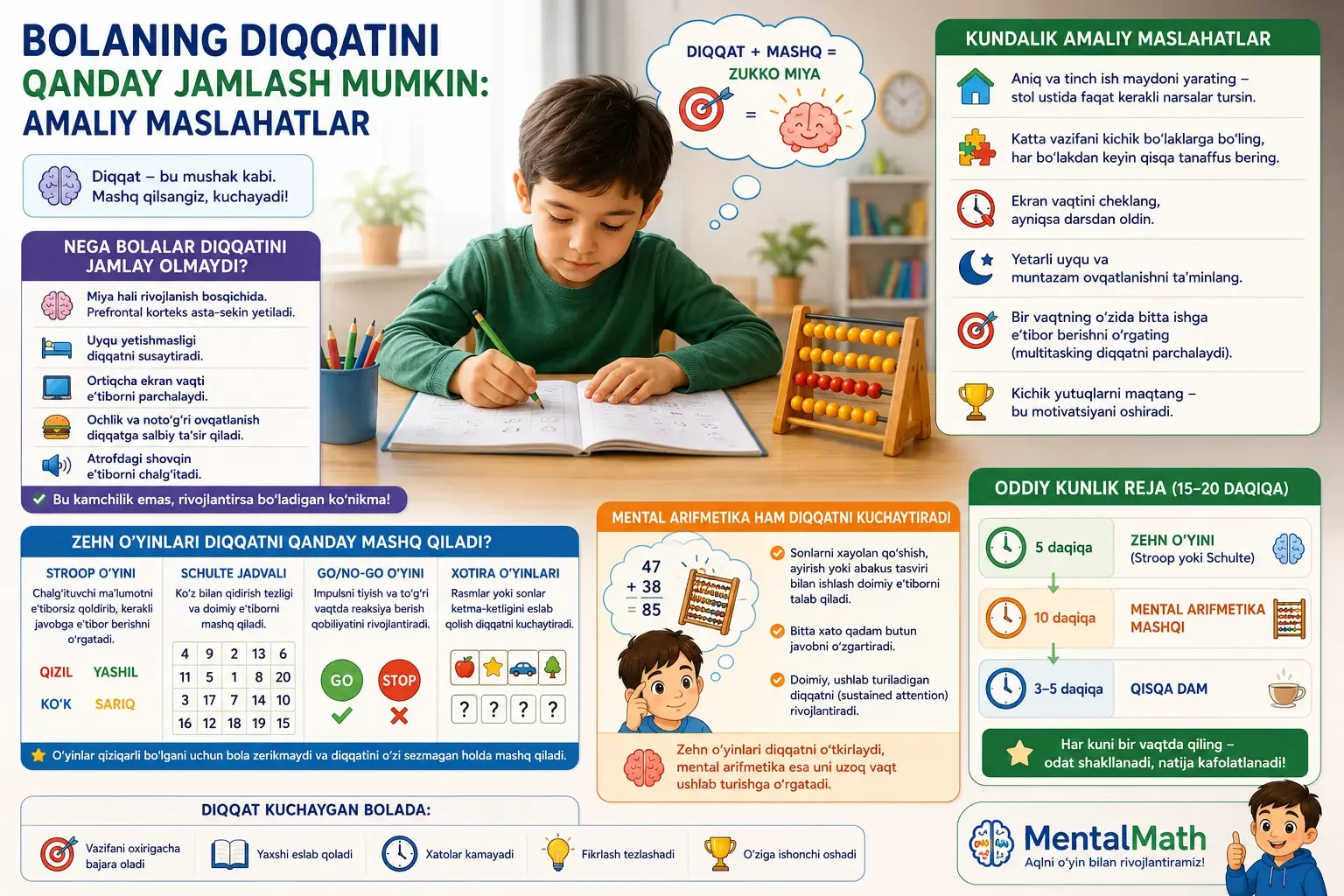
A child's brain is still developing. The area that manages attention (the prefrontal cortex) matures gradually with age, so it is completely normal for a young child to struggle to stay focused for long. On top of that, lack of sleep, too much screen time, hunger, and surrounding noise all weaken concentration. The key takeaway: this is not a flaw but a skill that can be developed.
Practical everyday tips
Simple daily habits turn out to be the most effective:
- Create a quiet, tidy workspace — keep only what is needed on the desk.
- Break a big task into small chunks with short breaks in between.
- Limit screen time, especially right before study.
- Ensure enough sleep and regular meals.
- Teach doing one thing at a time — multitasking fragments attention.
- Praise small wins — it boosts motivation.
How brain (zehn) games train attention
The "zehn" cognitive-games track on the MentalMath platform is built on targeted exercises. For example, the Stroop game teaches a child to ignore distracting information and focus on the correct answer. The Schulte grid trains visual search speed and sustained attention. Go/No-Go style games develop the ability to hold back an impulse and react at the right moment. Because the games are fun, the child does not get bored and trains attention without even noticing.
Mental arithmetic builds concentration too
Attention is trained not only by dedicated games but also by mental arithmetic. Adding or subtracting in your head, or working with an abacus image, forces a child to focus fully on every step — one wrong move changes the whole answer. This builds sustained attention. Mental arithmetic lessons complement the attention games: the games sharpen focus, while arithmetic teaches the child to hold it for longer.
A simple daily plan
Consistency brings the best results. Just 15-20 minutes a day is enough: 5 minutes of a brain game (Stroop or Schulte), 10 minutes of mental arithmetic, then a short rest. Doing this at the same time each day helps build a habit. MentalMath wraps this plan in a game-like format, so the child does not feel forced and wants to keep going on their own.
For the full picture of the method, its benefits and the best starting age, read our guide What is mental arithmetic?.