School readiness: what a 6-7 year old should know and be able to do
School readiness is about much more than knowing letters and numbers. For a 6-7 year old, what matters most is sensing what numbers really mean, being able to focus attention, remembering what they see, and understanding simple logical connections. These are the skills that help a child feel confident at school. The good news is that all of them can be built at home, through play, step by step.
What school readiness really means
Many parents measure readiness by how high a child can count or whether they can read. In reality, school readiness has several layers: intellectual (working with numbers and words), cognitive (memory, logic, attention), and emotional-social (following rules, patience). When these layers develop in balance, a child absorbs new knowledge more easily. That is why preparation should give attention not to one side only, but to both calculation and thinking skills.
Numeracy and number sense
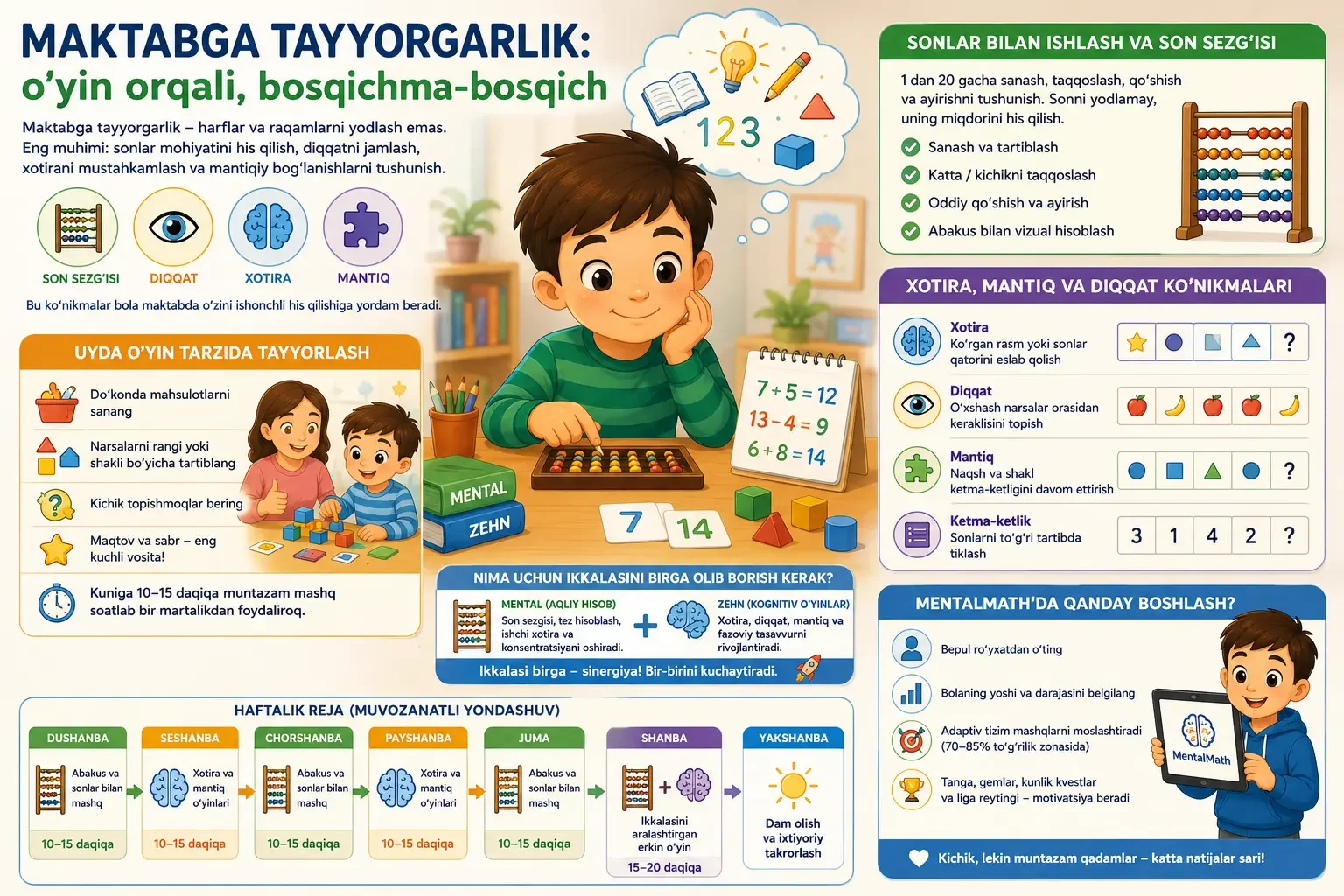
At 6-7, it helps for a child to count confidently from 1 to 20, compare numbers (bigger/smaller), and understand simple addition and subtraction. Here "number sense" — feeling the quantity rather than memorising mechanically — is crucial. Mental arithmetic and the basics of the abacus (soroban) strengthen exactly this sense: the child begins to picture numbers in their mind. The abacus lessons on MentalMath guide a child step by step, in a playful way, and help them make friends with numbers.
Memory, logic and attention skills
At school a child needs to remember the teacher's instructions, hold attention on a single task, and notice patterns. These skills can be practised with cognitive games:
- Memory: recalling a picture or a row of numbers just seen
- Attention: finding the right item among similar ones, comparing quickly
- Logic: continuing a pattern and a sequence of shapes
- Sequencing: restoring numbers in the correct order
The brain-training games on MentalMath practise these skills in an engaging, no-boredom way. For example, the number sequence game develops attention and logic at the same time.
How to prepare playfully at home
Preparation should not feel like a dull lesson. Instead of forcing your child, weave play into daily life: count items at the shop, sort objects by colour or shape, give little riddles. A regular 10-15 minutes a day is far more useful than one long session every now and then. Praise and patience are the strongest tools: support your child's effort even when they make mistakes.
A balanced weekly plan combining both tracks
The best results come from running the "mental" track (mental arithmetic) and the "zehn" track (cognitive games) together — they reinforce each other. A child with strong number sense solves games faster, while a child with sharp attention calculates without errors. A sample weekly plan: Monday, Wednesday, Friday — short practice with the abacus and numbers; Tuesday, Thursday — memory and logic games; Saturday — free play mixing both; Sunday — rest. MentalMath brings these two tracks together on one platform, matched to your child's age and level, so the plan is easy for parents to manage.
For the full picture of the method, its benefits and the best starting age, read our guide What is mental arithmetic?.