Vedic Mathematics: Nikhilam and Urdhva Explained
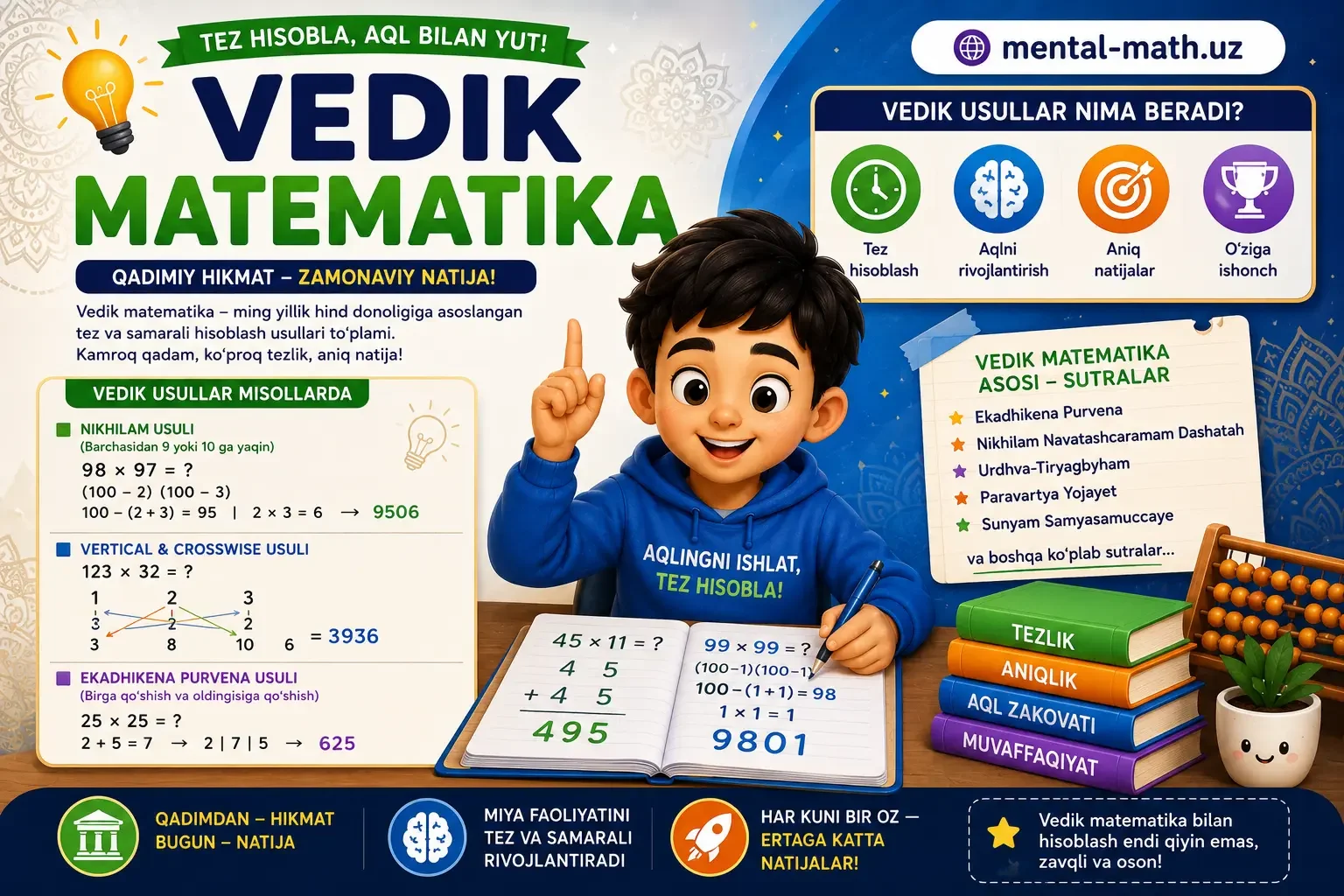
Vedic mathematics is one of the most widely taught fast-calculation systems in the world. It rests on 16 sutras — short, almost poetic rules. The system was formulated by the Indian scholar Bharati Krishna Tirthaji (1884-1960), whose book appeared in 1965, after his death.
One point deserves to be stated up front: many historians of mathematics doubt that these techniques were actually contained in the Vedas — most likely they are a twentieth-century development. That does not diminish their value: they work, they are elegant, and they show children the structure of numbers.
1. Nikhilam: multiplying by base 100
The sutra literally means "All from 9 and the last from 10". In practice the rule is simple: find each number's deficiency from 100.
Example: 98 × 97.
- Deficiencies: 100 − 98 = 2 and 100 − 97 = 3.
- Left part of the answer: subtract the other number's deficiency from either number — 98 − 3 = 95 (or 97 − 2 = 95, the same result).
- Right part: the product of the deficiencies — 2 × 3 = 06 (written as two digits).
Answer: 9506.
The method also works for numbers above 100, with addition instead of subtraction. 103 × 104: surpluses 3 and 4; left part 103 + 4 = 107, right part 3 × 4 = 12 → 10712.
2. Base 1000
The same logic applies to 1000 — only the right part becomes three digits.
Example: 994 × 998. Deficiencies 6 and 2. Left part: 994 − 2 = 992. Right part: 6 × 2 = 006. Answer: 992006.
Check it on a calculator — the result is correct. This "numbers near a round base" trick is the best-known part of Vedic mathematics.
3. Urdhva Tiryagbhyam: "vertically and crosswise"
This is the system's most general method: it works for any two numbers and replaces long multiplication. The idea is to multiply digits vertically and crosswise, summing the results by place value.
Example: 23 × 41.
- Units (vertical, right): 3 × 1 = 3
- Tens (crosswise): 2×1 + 3×4 = 2 + 12 = 14 → write 4, carry 1
- Hundreds (vertical, left): 2 × 4 = 8, with the carry 9
Answer: 943. Check: 23 × 41 = 943.
The method's strength is that it scales to three- and four-digit numbers — there are simply more crosses. And crucially, no intermediate lines need to be written down; the answer comes out in one pass.
4. Squares of numbers ending in 5
The Ekadhikena Purvena sutra ("by one more than the previous one") gives the easiest rule to remember:
65² = ? The digit before the 5 is 6. Multiply it by the next number up: 6 × 7 = 42. Append 25. Answer: 4225.
Likewise: 35² = 3×4=12 → 1225; 85² = 8×9=72 → 7225; 105² = 10×11=110 → 11025.
Vedic maths and the abacus are not rivals
Parents often ask which one is "better". In fact they solve different problems. The abacus and the friend formulas handle addition and subtraction, building visual imagery and working memory. Vedic techniques are mainly about multiplication, division and squares, and they build the ability to see number structure.
The usual optimal order: abacus and friend formulas first (ages 6-8), then the Trachtenberg rules and Vedic methods (from age 9). The reverse is possible, but if a child is shaky at addition, multiplication techniques will run slowly too.
How to practise
Take one sutra at a time. Week one — base-100 multiplication only (numbers 91-99). Week two — numbers above 100. Week three — squares. Save Urdhva for last: it is the most powerful method but demands the most concentration.
MentalMath has a lesson and an adaptive trainer for each sutra: Nikhilam (base 100), base 1000, Urdhva Tiryagbhyam and squaring.