
Big Friends (Pairs of 10): How Crossing the Ten Works
If small friends are mental arithmetic's first step, big friends are its most-used formula. This is the rule that lets a child move beyond a single rod and start working with tens. Schools call it "crossing the ten", and for many children it is the first real hurdle. The abacus makes that exact moment visible and physical.
What are big friends?
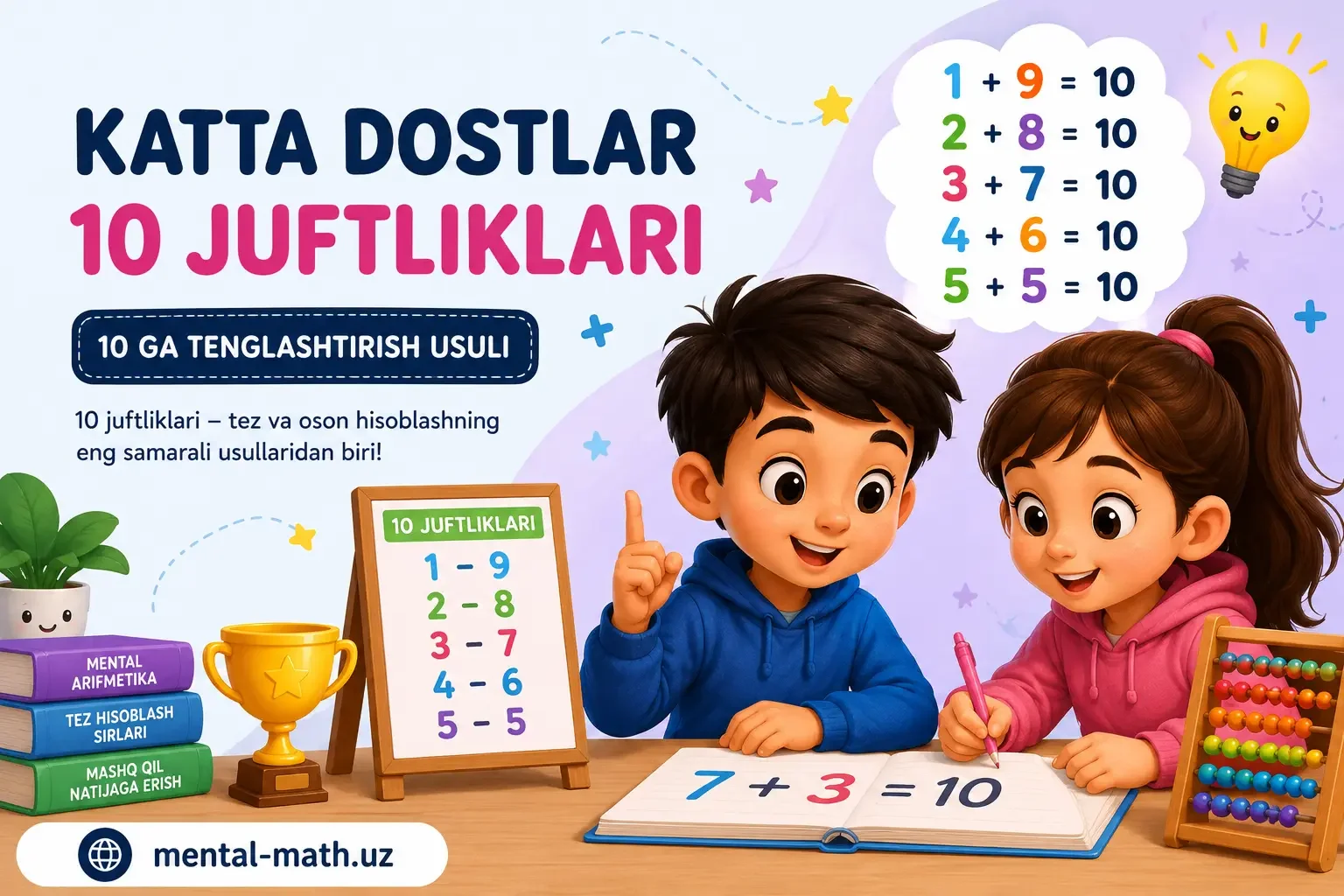
Big friends are the pairs that add up to 10:
- 1 and 9
- 2 and 8
- 3 and 7
- 4 and 6
- 5 and 5
These five pairs are the invisible skeleton of all elementary maths. A child who names them without hesitation speeds up not only on the abacus but in mental sums, column addition, and even counting money.
Addition rule: add 10, subtract the friend
When a rod has no room left, we add 1 to the next rod — the tens — and subtract the big friend from the current one.
- +9 = +10 − 1
- +8 = +10 − 2
- +7 = +10 − 3
- +6 = +10 − 4
- +5 = +10 − 5
Example: 7 + 8. The units rod shows 7 and 8 will not fit. The friend of 8 is 2. So we add one bead on the tens rod (that is +10) and subtract 2 from the units: 7 + 10 − 2 = 15. On the abacus, 1 on the left rod and 5 on the right.
Example: 6 + 9. The friend of 9 is 1: 6 + 10 − 1 = 15.
Subtraction rule: subtract 10, add the friend
- −9 = −10 + 1
- −8 = −10 + 2
- −7 = −10 + 3
- −6 = −10 + 4
- −5 = −10 + 5
Example: 12 − 7. The units show 2, so 7 cannot be taken away. The friend of 7 is 3: remove one bead from the tens and add 3 to the units: 12 − 10 + 3 = 5.
The interesting part: combined formulas
Sometimes even after applying a big friend the subtraction is still impossible — and that is when a small friend steps in. This stage is called a combined formula, and it is where a child's brain works hardest.
Example: 6 + 6. The units show 6 (5 above, 1 below). The big friend of 6 is 4, so: +10 − 4. The ten is added; now we must subtract 4 from the units — but only one bead sits below. Here the small friend applies: −4 = −5 + 1. Lift the upper 5 and add one lower bead. Final result: 6 + 10 − 5 + 1 = 12.
It looks complicated at first, but after a few dozen repetitions the hand remembers the movement on its own — much like playing the piano. Children usually pick this stage up faster than adults.
Common mistakes and how to fix them
Mistake 1: finding the friend by counting. "Friend of 7… 8, 9, 10 — so 3" kills speed completely. Fix: spend a few days on pairs alone, with no operations.
Mistake 2: forgetting the ten. The child subtracts the units correctly but forgets the left rod. Fix: lock the order of movements — tens first, always, then units.
Mistake 3: re-checking on fingers. If the child recounts the answer on their fingers, confidence is missing. Slow down and simplify the exercises — confidence matters more than speed.
How long it takes, and what comes next
Big friends usually take 4-8 weeks; with combined formulas, up to 2-3 months. Once this stage is done, the child can technically add and subtract numbers of any length, because a multi-digit operation is nothing more than these same formulas repeated.
Two directions then open up: moving to the imagined abacus through flash anzan, and multiplication methods — the Trachtenberg system and Vedic mathematics.
MentalMath has dedicated trainers for big friends and combined formulas, adapting automatically to the child's level. Open the big friends lesson or the crossing the ten lesson.