The Trachtenberg System: Multiplying by 11, 12, 9 and 6 Without Paper
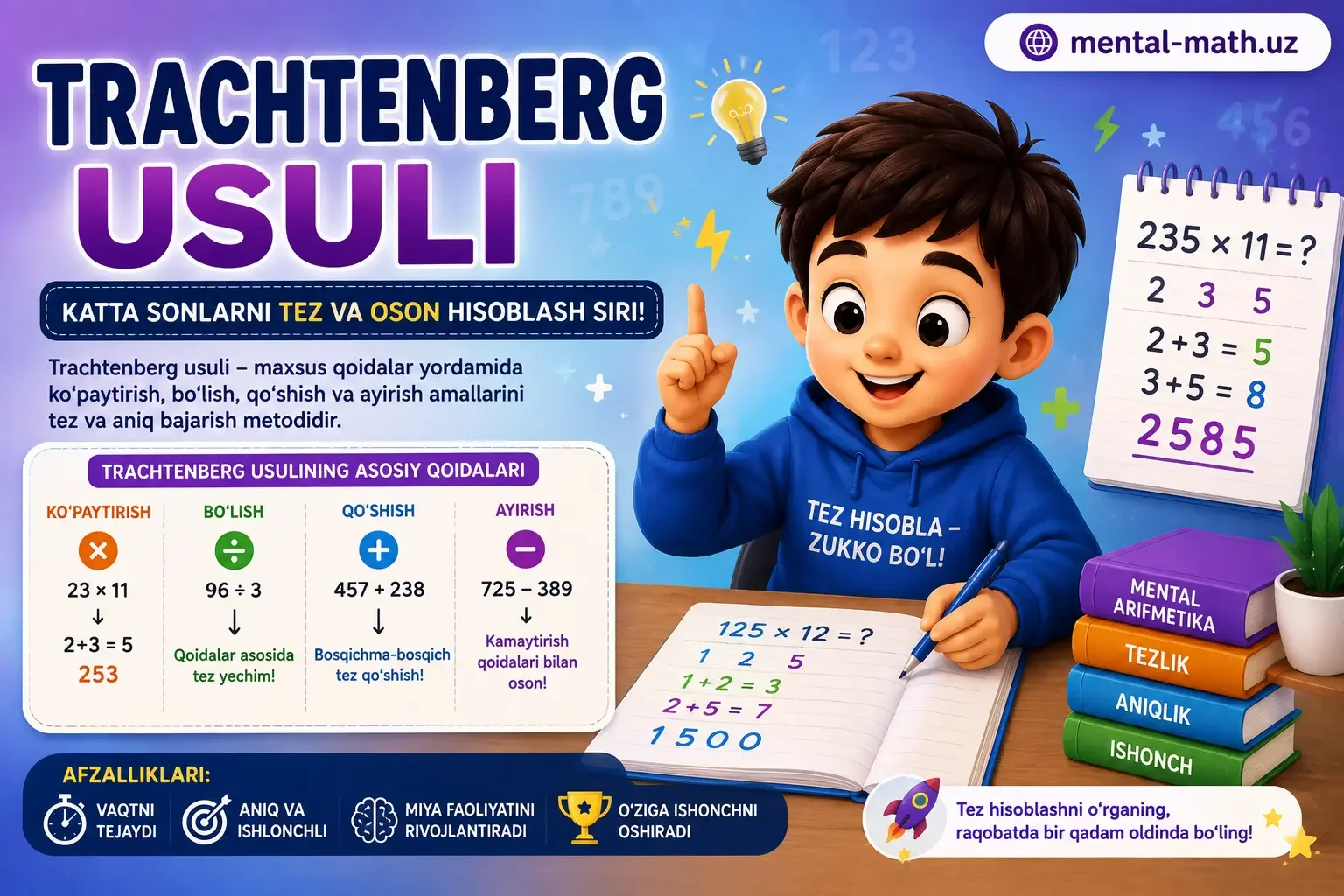
The Trachtenberg system has the most extraordinary origin story of any fast-calculation method. It was created by the Russian-born engineer Jakow Trachtenberg (1888-1953) inside a Nazi concentration camp, with no paper or pencil, entirely in his head. Calculation was how he kept his mind intact. After the war, in 1950, he opened a mathematical institute in Zurich and began teaching the system to children.
The core idea: you do not need to know the times tables — each multiplier has its own simple, mechanical rule. Adding, doubling and halving is enough.
The key concept: the "neighbour"
In Trachtenberg's rules, the neighbour is the digit immediately to the right of the current one. The rightmost digit has a neighbour of 0. Calculation always runs right to left, and the answer is written in that same order.
1. Multiplying by 11: add the neighbour
Rule: add each digit to its neighbour.
Example: 3425 × 11.
- 5 (no neighbour) → 5
- 2 + 5 = 7
- 4 + 2 = 6
- 3 + 4 = 7
- left edge: 3 → 3
Answer: 37675. If a sum exceeds 10, write the units and carry the ten into the next step: for 87 × 11 we get 7 → 7; 8 + 7 = 15 → write 5, carry 1; left edge 8 + 1 = 9 → 957.
2. Multiplying by 12: double and add the neighbour
Rule: double each digit and add its neighbour.
Example: 314 × 12.
- 2×4 + 0 = 8
- 2×1 + 4 = 6
- 2×3 + 1 = 7
- left edge: 3 → 3
Answer: 3768. Check it: 314 × 12 = 3768. The same logic gives rules for 13 (triple and add the neighbour) and 14 (quadruple and add the neighbour).
3. Multiplying by 9: a three-step rule
One of the most elegant rules:
- rightmost digit: subtract it from 10;
- middle digits: subtract each from 9 and add the neighbour;
- left edge: subtract 1 from the first digit.
Example: 623 × 9.
- 10 − 3 = 7
- 9 − 2 + 3 = 10 → write 0, carry 1
- 9 − 6 + 2 = 5, with the carry 6
- left edge: 6 − 1 = 5
Answer: 5607. Indeed, 623 × 9 = 5607.
4. Multiplying by 6: half the neighbour
Rule: add half of the neighbour to each digit (drop any fraction), and if the digit itself is odd, add 5 more.
Example: 42 × 6.
- 2: neighbour 0, digit is even → 2
- 4: neighbour 2, half is 1 → 4 + 1 = 5
- left edge: half of 4 = 2
Answer: 252. The rule for 5 works the same way: take half the neighbour and add 5 for an odd digit.
Who is this system for?
The Trachtenberg method suits two groups especially well. First, children who struggle with the times tables: a rule is more mechanical and more reliable than rote memory, and confidence follows. Second, children who already calculate well: the method teaches them to see numbers from a new angle.
To be honest about it: Trachtenberg's rules are not universal. Each multiplier has its own rule, and learning them all is a substantial job in itself. In practice people learn the most useful ones — 11, 12, 9 and 6 — and use the general-purpose techniques of Vedic mathematics for everything else.
How to practise
Take one rule and drill it on two-digit numbers only for a week. Have the child say the rule out loud. In week two move to three-digit numbers, in week three to a new rule. Learning two rules at once is the most common mistake — the child starts confusing them.
MentalMath has a dedicated interactive lesson and trainer for each rule: Magic 11, multiplying by 9, multiplying by 12. For general fast-calculation techniques, see our separate article.