
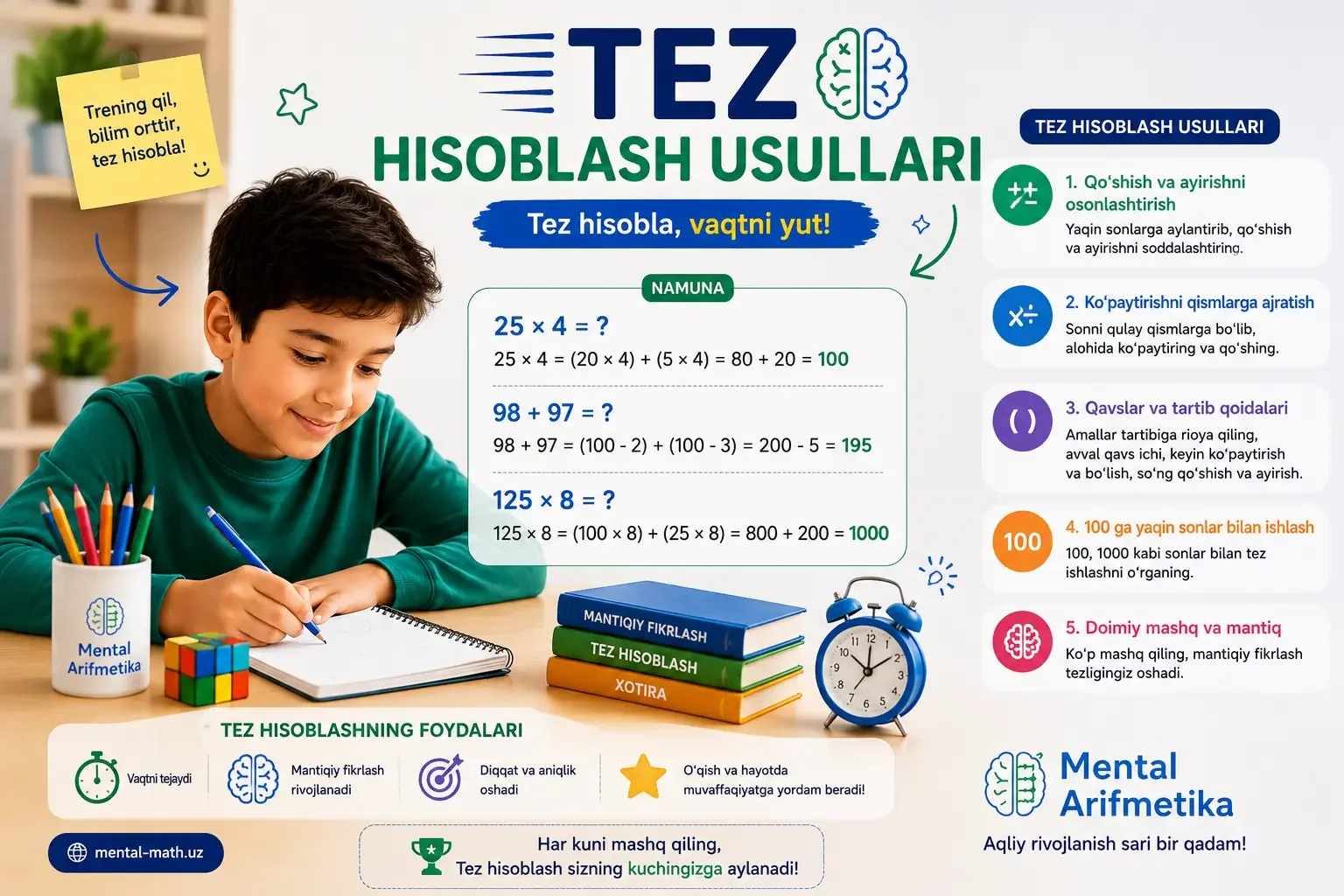
Fast Calculation Techniques: 7 Ways to Speed Up Mental Math
Who needs fast calculation techniques when everyone has a calculator in their pocket? The truth is, mental math is not just a way to get an answer — it is one of the best workouts for the brain. Working with numbers in your head trains attention, working memory and logical thinking all at once. A child solves school problems faster, and an adult stops fearing numbers at the store, at work and in everyday life. Below are 7 concrete techniques that help you solve math faster — each with worked examples you can start using today.
1. Rounding to the nearest ten
The simplest and most-used trick: turn an awkward number into a nearby round one, then give the difference back. For example, to compute 99 + 47, treat 99 as 100: 100 + 47 = 147, then subtract the extra 1 — the answer is 146. Another example: 298 + 156. Here 298 ≈ 300, so 300 + 156 = 456, now subtract 2: 454. Subtraction works the same way: 63 − 29 = 63 − 30 + 1 = 34. This technique trains your brain to look for a "friendly number" — the very foundation of fast calculation.
2. Adding and subtracting in chunks
Don't handle big numbers all at once — break them into place values: hundreds first, then tens, then units. For example, 348 + 235: hundreds 300 + 200 = 500, tens 40 + 30 = 70, units 8 + 5 = 13. Now combine: 500 + 70 + 13 = 583. For subtraction, peel off the second number piece by piece: 725 − 348 = 725 − 300 − 40 − 8 = 425 − 40 − 8 = 385 − 8 = 377. Unlike column arithmetic on paper, this works left to right — exactly how mental arithmetic masters calculate.
3. The magic of multiplying by 11
There is a wonderful way to multiply a two-digit number by 11: write the digits at the two ends and put their sum in the middle. For example, 23 × 11: 2 and 3 at the ends, 2 + 3 = 5 in the middle — the answer is 253. Another example: 45 × 11 = 495, because 4 + 5 = 9. If the sum exceeds 10, write the units digit in the middle and carry the ten to the left digit: for 68 × 11, 6 + 8 = 14, so we write 4 in the middle and 6 + 1 = 7 — the answer is 748. The full explanation and an interactive trainer are in the Magic 11 lesson.
4. Multiplying by 9: 10x − x
You don't need to memorize a table to multiply by 9: multiply the number by 10 and subtract it once. For example, 9 × 47 = 470 − 47 = 423. Or 9 × 86 = 860 − 86 = 774. Multiplying by 10 is just adding a zero, and the subtraction is easy with the chunking technique above. The same logic works for 99: 99 × 23 = 2300 − 23 = 2277. For step-by-step practice, try the multiplying by 9 lesson.
5. Multiplying and dividing by 5
Five is half of ten — let's use that. To multiply: multiply the number by 10 and divide by 2. For example, 24 × 5 = 240 ÷ 2 = 120. It works with larger numbers too: 137 × 5 = 1370 ÷ 2 = 685. To divide, do the reverse: multiply by 2 and divide by 10. For example, 480 ÷ 5 = 960 ÷ 10 = 96, or 84 ÷ 5 = 168 ÷ 10 = 16.8. After a few practice rounds, any operation with a five will take you a single second.
6. Squaring numbers ending in 5
The square of any number ending in 5 can be found in seconds. The rule: drop the final 5, multiply the remaining number by the next number up, then write 25 at the end. For example, 35²: 3 × 4 = 12, append 25 — the answer is 1225. Another one: for 65², 6 × 7 = 42, so the answer is 4225. Even 85² is easy: 8 × 9 = 72, giving 7225. Why this works, along with other squaring tricks, is covered in the squaring lesson.
7. The Vedic "base difference" method
For multiplying two numbers close to 100 there is an elegant technique from ancient Vedic mathematics. Find each number's difference from 100. For example, 98 × 97: the differences are 2 and 3. The first part of the answer is either number minus the other's difference: 98 − 3 = 95 (or 97 − 2 = 95 — same result). The second part is the product of the differences: 2 × 3 = 06. The answer: 9506. Another example: 96 × 94. The differences are 4 and 6, the first part is 96 − 6 = 90, the second part is 4 × 6 = 24 — the answer is 9024. The method works with a base of 1000 as well. The full explanation is in the Vedic Nikhilam lesson.
These techniques don't work without practice
Nobody becomes a fast calculator by reading these 7 techniques once — just as you can't learn to ride a bicycle from a book. The secret is simple: 10 minutes of regular practice a day. Within a week, rounding becomes an automatic habit; within a month, the magic of 11 and 9, the squares and the Vedic method start firing in your head on their own. The MentalMath platform has interactive trainers for every one of these techniques: exercises adapt to your level, results are tracked, and kids learn through games and adventures without getting bored. Browse the full list of techniques in the methods catalog and start your first practice session today.
For the full picture of the method, its benefits and the best starting age, read our guide What is mental arithmetic?.