Small Friends (Pairs of 5): The First Step on the Abacus
Every child who starts working with an abacus runs into the same wall very quickly: the lower beads run out. Say a rod shows 3 and the child needs to add 4 more — but only one free bead is left below. This is exactly where mental arithmetic's first real formula, the small friends, comes in. In this article we explain what the rule is, why it matters so much, and how to practise it with a child step by step.
A quick look at the abacus
On a soroban (the Japanese abacus) each rod has five beads: one upper "heaven" bead and four lower "earth" beads. The upper bead is worth 5, each lower bead is worth 1. So a single rod can show any digit from 0 to 9: to show 7, you bring the upper 5 down and lift two lower beads.
Here is the key point: there are only 4 beads below. That means a child can add at most 4 "directly". Anything more needs a different route — and that route runs through the number 5.
What are small friends?
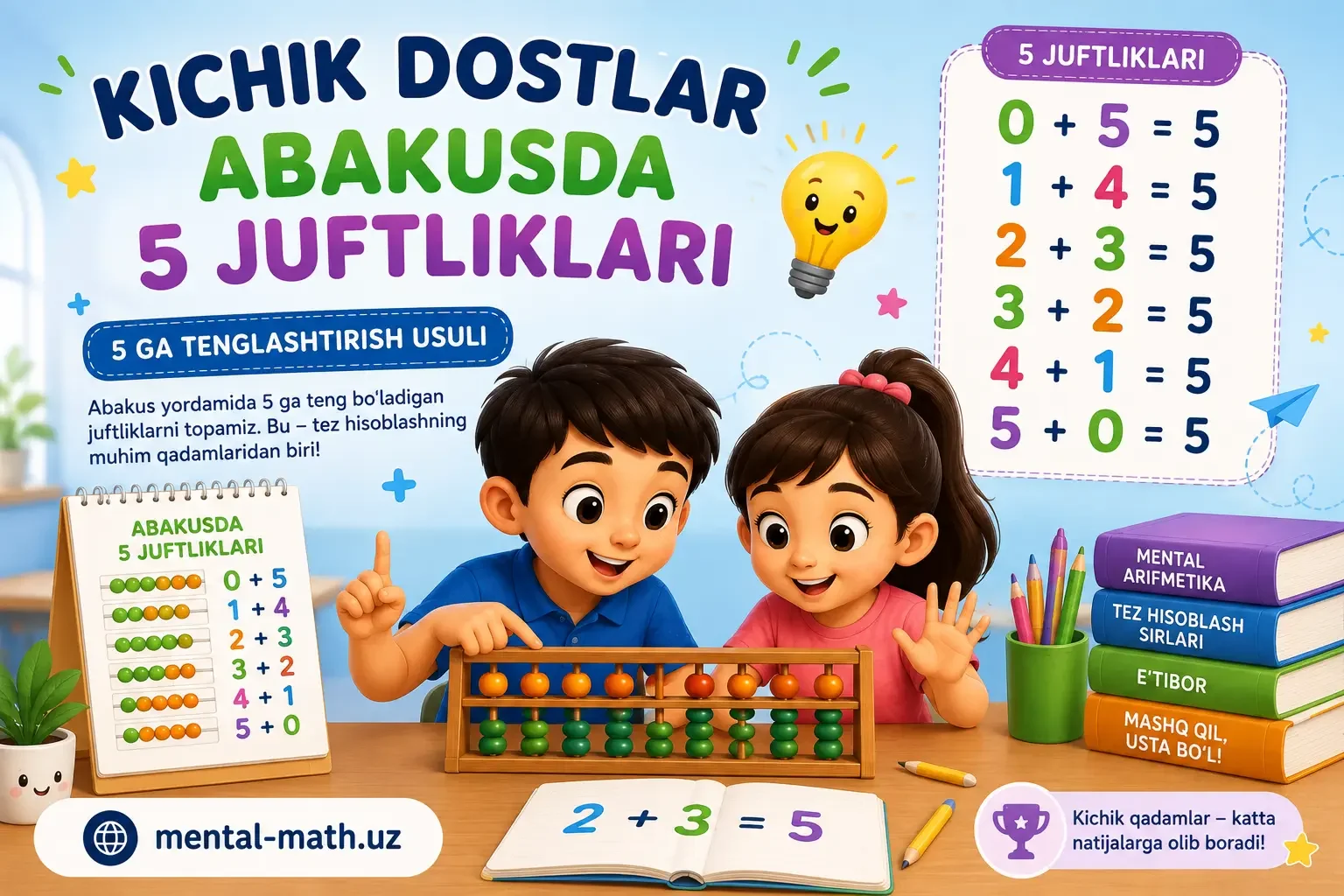
Small friends are number pairs that add up to 5:
- 1 and 4
- 2 and 3
- 3 and 2
- 4 and 1
A child should know these pairs as automatically as a multiplication table. Asked "who is the friend of 4?", they should answer "1" without thinking. That automaticity is the foundation of every stage that follows.
Addition rule: add 5, subtract the friend
When a number cannot be added directly, do this: +5 and subtract the small friend.
- +1 = +5 − 4
- +2 = +5 − 3
- +3 = +5 − 2
- +4 = +5 − 1
Example: 3 + 4. The rod shows 3 and only one free bead is left below — 4 cannot be added. Apply the formula: the friend of 4 is 1, so bring the upper 5 down and return one lower bead. Result: 3 + 5 − 1 = 7.
Example: 4 + 3. The friend of 3 is 2: 4 + 5 − 2 = 7. On the abacus this is one smooth motion — upper bead down, two lower beads back.
Subtraction rule: subtract 5, add the friend
For subtraction the formula flips: −5 and add the small friend.
- −1 = −5 + 4
- −2 = −5 + 3
- −3 = −5 + 2
- −4 = −5 + 1
Example: 7 − 4. The rod shows 7 (5 above, 2 below). You cannot subtract 4 from below — only 2 beads are there. Formula: the friend of 4 is 1, so lift the upper 5 and add one lower bead: 7 − 5 + 1 = 3.
Why this is brain training, not a trick
Parents often ask: "3 + 4 = 7 can simply be memorised, why complicate it?" The answer is that the goal is not the answer — it is the method. The child learns to split a number into parts (4 = 5 − 1), that is, to see the structure of numbers. This skill later transfers to pairs of 10, to multi-digit numbers, and finally to the imagined abacus.
On top of that, every operation is split into two movements performed in sequence — training working memory and action planning. That is precisely what separates mental arithmetic from ordinary counting.
How to practise with your child
Step 1. Pairs only: "friend of 2?" — "3". Three to five minutes a day with flashcards is enough, no abacus needed.
Step 2. Addition on a single rod: 1+4, 2+3, 3+3, 4+4. Have the child say the formula out loud each time: "adding four — friend is one — five down, one off".
Step 3. Move to subtraction, then mix addition and subtraction.
Step 4. Build speed with a stopwatch. Speed up only once the work is error-free — otherwise a wrong habit gets locked in.
This stage usually takes 3-6 weeks. Do not rush it: if small friends are shaky, the next topic — pairs of 10 — will feel heavy.
What comes next?
Once small friends are solid, the child moves on to big friends (pairs of 10), where the second rod — the tens — enters the picture. After that both formulas combine, and from then on the child can handle multi-digit numbers of any size.
MentalMath has a dedicated interactive trainer for small friends: exercises adapt to the child's level and the types they get wrong are repeated automatically. Start with the abacus lesson or explore the friends of 10 lesson. For the bigger picture, read What is mental arithmetic?