How to Memorize the Multiplication Table Easily and Fast
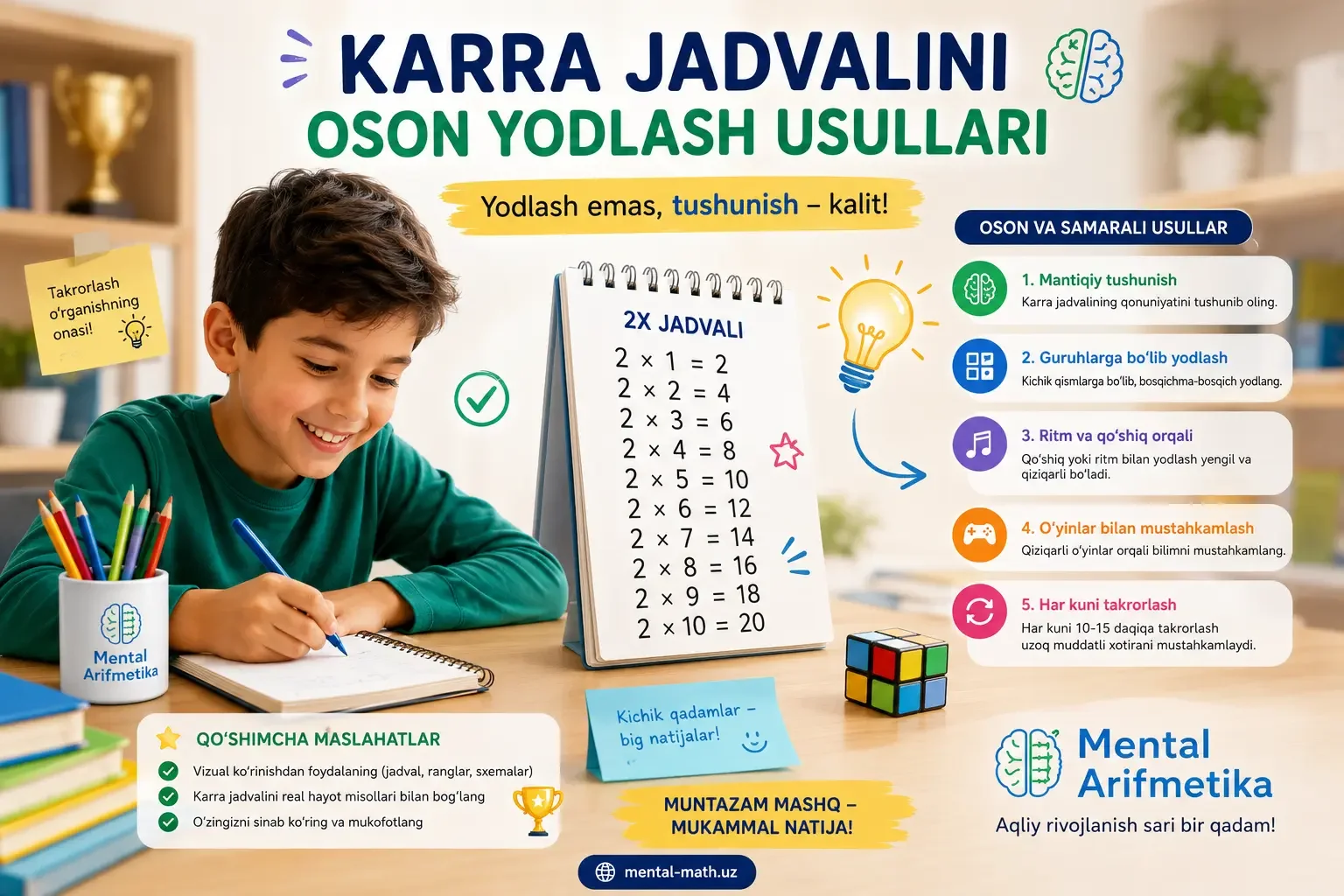
The multiplication table is one of the most important foundations of primary maths. Division, fractions, percentages and even algebra all rest on it. Yet many parents face the same picture: the child crams the facts in the evening and forgets them by morning, and practice turns into tears and excuses. The good news is that memorizing the multiplication table is not about dry drilling — with the right approach the process can be easy, fast and even fun. Below is a proven step-by-step path.
Why do children struggle with the multiplication table?
The problem is not that the child "isn't capable". Most often the method is to blame:
- The child is made to memorize 100 cells without ever understanding what multiplication means — and meaningless information sticks poorly in memory.
- Everything is given at once: tables 2 through 9 in a single week. The brain simply cannot absorb that much at the same time.
- Repetition is boring, and anything learned without emotion fades quickly.
- Mistakes are punished — and the child develops a fear of maths. We wrote about this in detail in our article on helping a child overcome fear of maths.
So the task is clear: shrink the amount to memorize, fill it with meaning, and turn the process into a game. Let's see how.
Understanding comes first: multiplication is repeated addition
The first step should always be an explanation. Show your child that 3 × 4 is not just "twelve" but "taking 3 four times", that is 3 + 3 + 3 + 3. Do it with real objects: lay out sweets in 4 rows of 3 and count them together. Once a child sees with their own eyes that multiplication is repeated addition, the table stops being a secret code and becomes a logical system. Most importantly, the child can now rebuild a forgotten fact on their own: if 6 × 7 slips their mind, they add one more 6 to 6 × 6 = 36. That confidence solves half the battle.
An easy order: 1, 2, 5 and 10 first — then 3 and 4
There is no need to learn the table in order from 2 to 9. Going from easy to hard works far better:
- 1 and 10 — require almost no memorizing: multiplying by 1 changes nothing, multiplying by 10 just adds a zero. On day one the child already feels a win: "I know part of the table!"
- 2 — is simply counting in twos: 2, 4, 6, 8... Children pick this up quickly.
- 5 — the answers always end in 5 or 0, and they connect nicely to the clock (five-minute marks).
- 3 and 4 — are learned through rhythmic skip-counting and repeated addition. You can explain 4 as "double the 2s": 4 × 6 = 2 × 6 + 2 × 6.
By this stage the child already owns most of the table — and what remains is far less than it seems.
The symmetry secret: 3 × 7 = 7 × 3
The biggest "secret" of the multiplication table is the commutative property. 3 × 7 and 7 × 3 give the same answer, so if a child knows 3 × 7 from the 3s table, there is nothing new to memorize in 7 × 3 from the 7s table. Make this visible: draw a 100-cell grid and colour in the learned cells together. After mastering 1, 2, 5, 10, 3 and 4, the child will see that thanks to symmetry many cells in the 6s, 7s, 8s and 9s are already "green". In fact the truly new, hard combinations in the whole table number only about 15-20: 6 × 7, 6 × 8, 7 × 8, 8 × 9 and the like. The very thought "not 100, only about 20" gives a child's motivation a huge boost.
Finger tricks and patterns: the magic of 9 and 5
Some tables come with their own "tricks", and children love them:
- The 9s finger trick: stretch out both hands; for 9 × 4 fold down the fourth finger from the left. Three fingers remain to the left of the folded one and six to the right — the answer is 36. The trick works from 9 × 1 to 9 × 10. A step-by-step explanation is on our multiplying by 9 technique page.
- The 9s pattern: the digits of every answer add up to 9 (18, 27, 36, 45...), and the first digit is one less than the multiplier. If a child "discovers" this pattern on their own, they will never forget it.
- The 5s pattern: even number × 5 — take half and add a zero (8 × 5 → 4 → 40), while an odd number × 5 always ends in 5.
Once the table is mastered, show your child the next step — the magic of multiplying by 11 and the multiplying by 12 technique. These "beyond the table" tricks spark real pride: "I can handle big numbers too!"
Reinforce through play: 10-15 minutes a day
Anything learned but not reinforced fades within a week. The most effective recipe is short but daily practice: 10-15 minutes a day is enough. Just make it a game rather than a dull quiz: ask "what's 7 × 6?" while waiting for the bus, play card games with the answers, hold a "who answers faster" contest. On the MentalMath platform, multiplication-table exercises are built on exactly this principle: the child answers against the clock, earns points and coins, and the difficulty adapts automatically to their level. When repetition becomes a game, children start asking to practise on their own. As extra support for retention, we also recommend memory games for children — a strong memory holds on to the table faster too.
Mistakes are not the enemy: the parent's role
If your child answers "48" to 6 × 7, the worst response is "wrong again!" It breeds fear and defensiveness, and a frightened brain remembers poorly. Instead, turn the mistake into a moment of discovery: "So close! What is 6 × 6? 36. Now let's add one more 6." The child then finds the answer themselves, and that success belongs to them. Another key rule: never compare your child with others — compare them only with their yesterday's self: "Last week you made 5 mistakes, today only 2!" Celebrate small wins and be patient with the process — usually 2-3 months of regular, step-by-step practice is enough to master the whole table solidly.
Conclusion
The secret of learning the multiplication table easily rests on four pillars: understanding first (multiplication is repeated addition), then an easy order (1, 2, 5, 10 → 3, 4 → the rest), cutting the workload in half through symmetry, and finally 10-15 minutes of playful daily review. Follow this path and cramming turns into a chain of victories — and your child ends up loving maths.
For the full picture of the method, its benefits and the best starting age, read our guide What is mental arithmetic?.