Games that develop a child's memory
Many parents worry that their child forgets things quickly. In truth, this is not a fixed trait but a skill that can be strengthened gradually with the right games.
What working memory is and why it matters
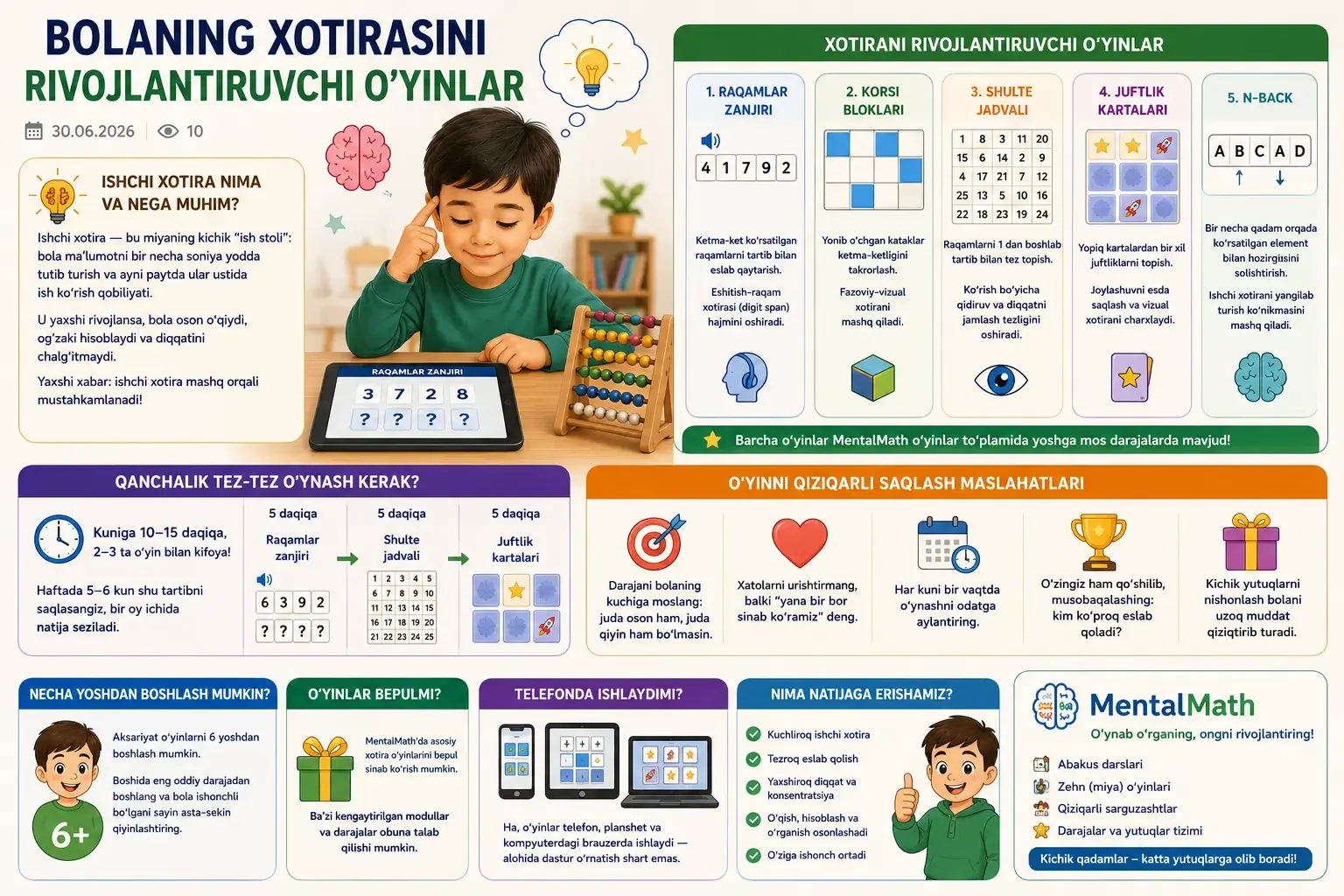
Working memory is the brain's small "desktop": the ability to hold a problem, a teacher's instruction or a sentence in mind for a few seconds while actively working with it. When it is well developed, a child reads with understanding, calculates in their head and stays focused without drifting off. The good news is that working memory, like a muscle, grows with practice.
Games that build memory
Each game below trains a different side of memory, so it is best to rotate between them:
- Number Chain — recall and repeat a sequence of numbers in order. It increases your child's digit span (memory for numbers).
- Corsi Blocks — repeat a sequence of tiles that light up. It trains visuospatial memory.
- Schulte Grid — find numbers in order as quickly as possible. It improves visual search and sustained attention.
- Memory Cards — find matching pairs among face-down cards. It sharpens location recall and visual memory.
- N-Back — compare the current item with the one shown a few steps back. It trains updating information in working memory.
All of these games live in the MentalMath games catalog and adapt to your child's age. For example, the Schulte Grid game builds attention, while the Number Chain game gradually expands memory for numbers.
How often to play
Short, regular sessions work better than rare long ones. Around 10-15 minutes a day with 2-3 games is plenty. For example: 5 minutes of Number Chain, 5 minutes of Schulte Grid, 5 minutes of Memory Cards. Keep this routine 5-6 days a week and you should notice progress within about a month.
Tips to keep it fun
Memory practice should never feel like a chore. A few simple tips: match the level to your child so it is neither too easy nor too hard; instead of scolding mistakes, say "let's try once more"; play at the same time each day so it becomes a habit; and now and then join in yourself and turn it into a friendly contest over who remembers more. Celebrating small wins keeps a child interested over the long run.
From what age can we start?
Most games are suitable from age 6. Begin at the easiest level and raise the difficulty as your child grows more confident.
Are the games free?
On MentalMath the core memory games can be tried for free. Some advanced modules and levels may require a subscription.
Do they work on a phone?
Yes, the games run in the browser on phones, tablets and computers — there is no need to install a separate app.
For the full picture of the method, its benefits and the best starting age, read our guide What is mental arithmetic?.