How to Help a Child Who Is Afraid of Math
If your child slumps their shoulders at the word "math" and says "I can't do this," you are not alone. Math anxiety is very common, and it has little to do with how smart your child is - it's about emotions. The good news: this fear can be overcome. With the right approach, math turns from a scary task into an enjoyable game. Let's look at where the fear comes from and what you, as a parent, can do.
Where does math fear come from?
Fear often starts with a few negative experiences: feeling embarrassed by a mistake at the board, running out of time on a timed test, or constantly hearing that "math is hard." The child begins to fear making mistakes and forgets that mistakes are a natural part of learning. Sometimes the fear is passed on by parents themselves: when you say "I hated math in school too," the child takes it as a signal.
Signs of math anxiety
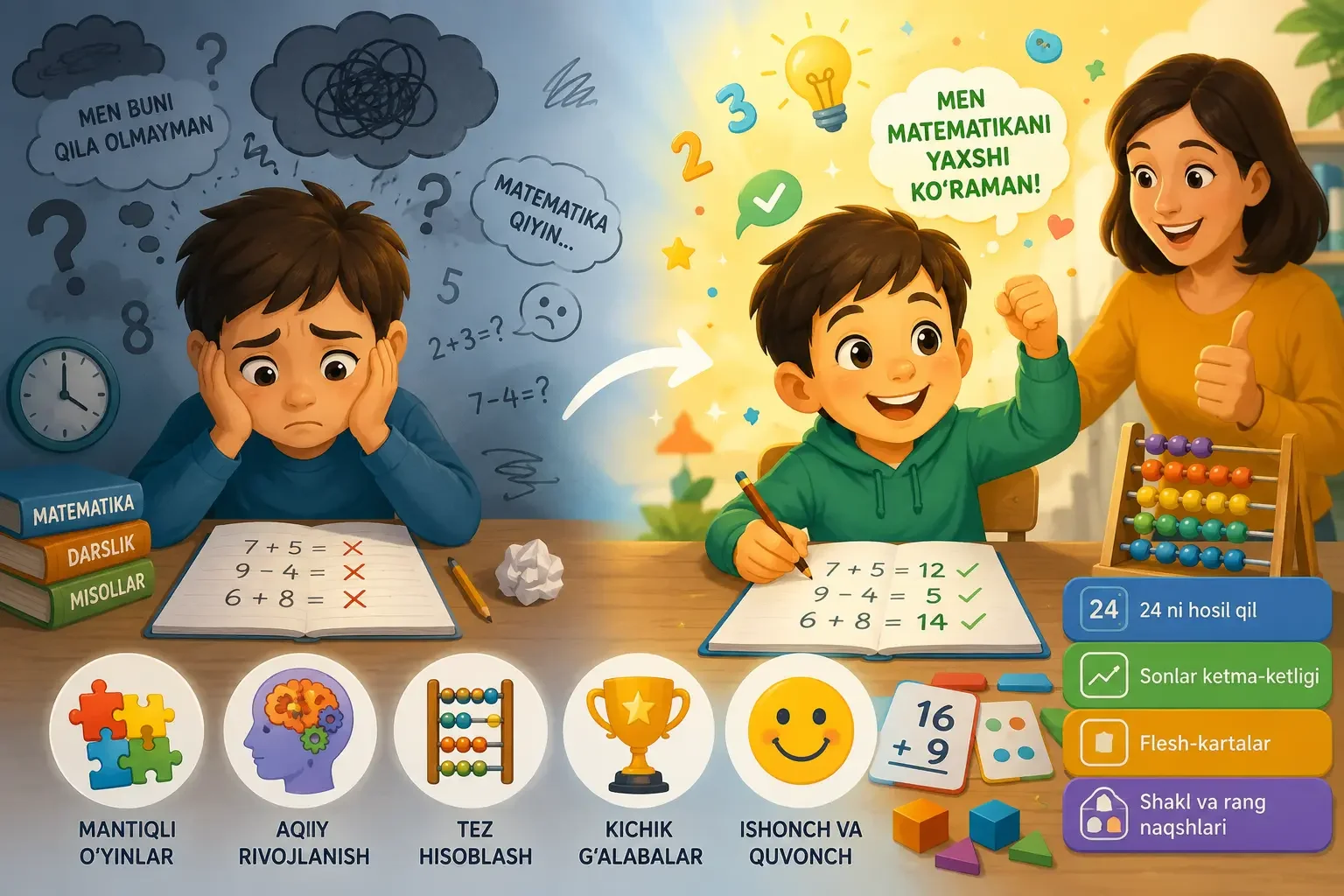
You can spot math anxiety by these signs: your child constantly puts off math homework, gets nervous at the sight of numbers, says "I don't know" even for a simple problem, or complains of a stomachache or cries before a lesson. These signs don't mean laziness - they mean your child needs support. The first step is to acknowledge the fear and show your child that making mistakes is okay.
Turn math into play: quick wins
The most powerful way to beat fear is to let your child feel small victories. Mental arithmetic is perfect for this: it teaches simple, fast tricks without heavy formulas. For example, the friend of 10 method teaches kids to add numbers in quick pairs - and the first time your child says "I solved that fast!", pride replaces fear. Every quick correct answer sends the brain a signal: "I can handle math." On the MentalMath platform these tricks are taught as games in short exercises, so the child doesn't get tired or overwhelmed.
Logic and number games build confidence
MentalMath combines two tracks: "mental" (mental arithmetic) turns calculation into a fast skill, while "zehn" - logic and cognitive brain games - turns thinking into play. Together they remove fear. The child feels like they're playing, but they're actually training their brain:
- Make 24 - reach 24 using four numbers, turning calculation into a puzzle;
- number sequences and find-the-missing-number - build pattern recognition and logic;
- flash cards and memory games - boost speed and focus;
- shape and color patterns - strengthen cognitive flexibility.
In games like these the child feels no "right or wrong" pressure - they simply play and win. You can browse all the games in the learning section.
Tips for parents
In overcoming fear, you are the most important person. Praise effort, not the result: saying "you didn't give up on a hard problem - well done" gives your child confidence. Keep sessions short - 10-15 minutes a day is better than overload. Don't compare your child to others and don't rush them on time. When they make a mistake, don't get angry - say "let's look at it together." Step by step, math turns from a scary subject into a joyful daily game - and the day will come when your child says "I love math."
For the full picture of the method, its benefits and the best starting age, read our guide What is mental arithmetic?.