Your Child Counts on Fingers: Should You Stop It, and How?
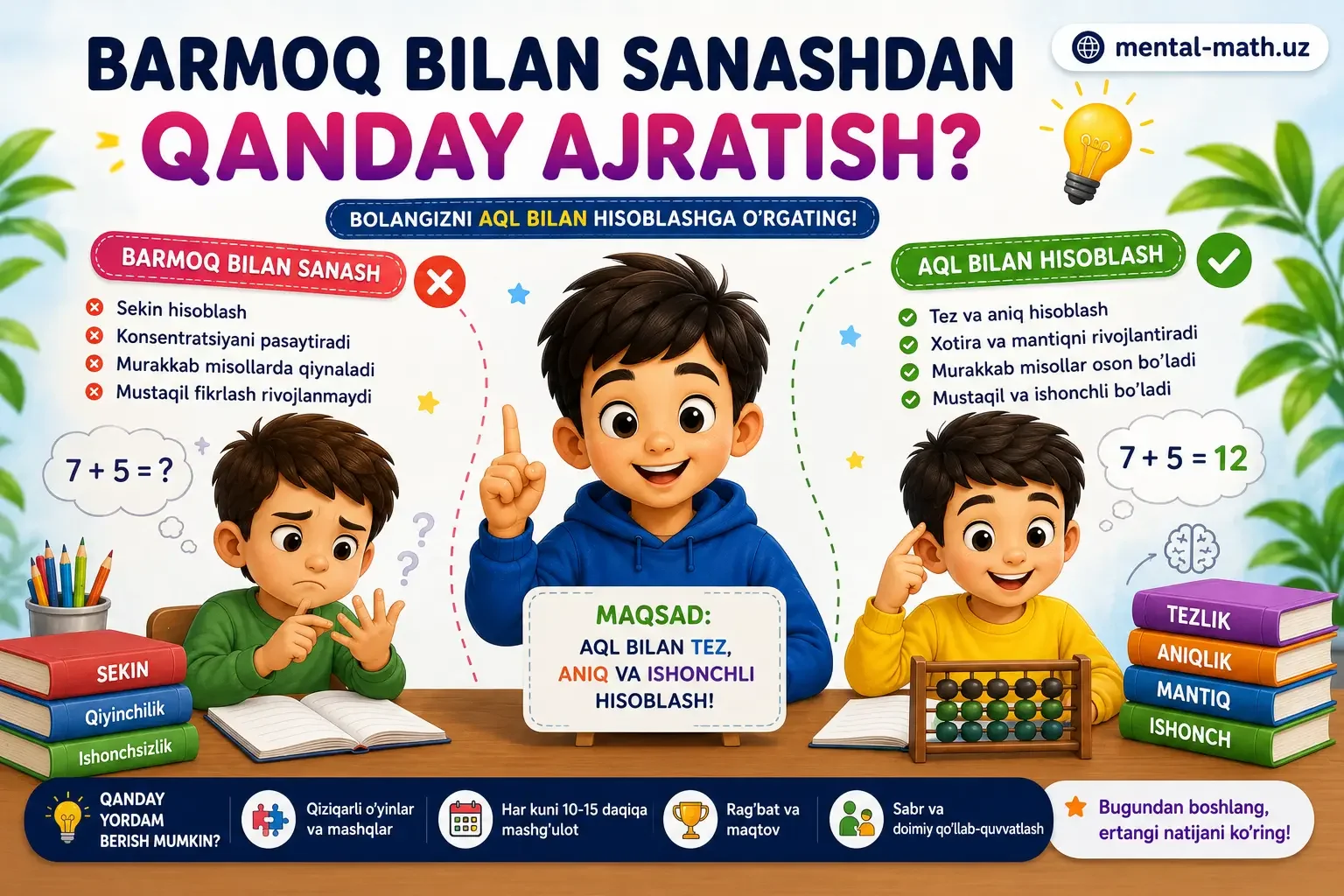
"My child is in second grade and still counts on their fingers — how do I stop it?" This is one of the most common questions parents ask. And the answer is almost always the opposite of what they expect: banning it is the worst strategy.
Why finger counting is not a bad thing
Fingers are a child's first natural calculating tool. They make a number visible and touchable: three is not the abstract word "three" but three raised fingers. Research in cognitive development has shown that a child's ability to sense their own fingers ("finger gnosis") is linked to later mathematical achievement.
The problem is not the fingers — it is which stage the child is stuck at. Calculation normally passes through four stages:
- Counting all: for 3 + 4 the child raises 3 fingers, then 4, and recounts everything from the start.
- Counting on: starting at "three" and taking four steps forward.
- Decomposition: 3 + 4 = 3 + 3 + 1, or 7 = 5 + 2 — splitting numbers into parts.
- Retrieval: the answer is simply known.
Every child begins at the first stage. The real warning sign is different: still counting all at age 8-9. In that case the issue is not the fingers but an unclear sense of how numbers are built.
Why banning does not work
Ban the fingers and the child does not stop counting — they simply hide it: under the table, on their toes, or with small head nods. On top of that, fear of mistakes appears, calculation slows down and maths becomes a "dangerous" subject. That is exactly how maths anxiety forms.
The right approach is not to forbid but to make fingers unnecessary. As soon as the child finds a faster, more reliable method, they drop the fingers on their own.
Five practical steps
Step 1: train recognition without counting (subitising). Show dots, buttons or a die face for one second and ask "how many?" — from 1 to 5. The goal is recognition at a glance, without counting. This is the skill that lifts a child out of the "counting all" stage.
Step 2: automate the pairs of 5 and 10. "How much do we add to 4 to make 10?" should be answered without hesitation. On the abacus these pairs are called small friends and big friends, and they are the foundation of all mental arithmetic.
Step 3: swap fingers for an external tool. It sounds paradoxical, but it works: replace fingers with an abacus. The difference is that showing 7 on an abacus does not require counting seven times — one "five" bead and two units are enough. This is how a child learns to decompose numbers.
Step 4: remove the pressure to be fast. "Faster!" only reinforces counting, because an unsure child falls back on the most familiar method. Accuracy and method first; speed follows by itself.
Step 5: short daily practice. Ten minutes a day beats an hour once a week by a wide margin. Regularity is what decides the outcome here.
When to seek professional advice
If several of these signs coincide, it is worth talking to a teacher or specialist: the child is over 9 and still recounts every operation from scratch; after months of practice they still cannot recall pairs within 10; they mix up digit order when writing (13 and 31, for instance); they become physically anxious before maths. These can be signs of dyscalculia — and early identification matters.
The bottom line
Finger counting is not an illness — it is a stage. The task is not to eliminate it but to carry the child on to the next stage: decomposing numbers and working with mental images. This is exactly where mental arithmetic helps — it makes numbers visible and hands the child a tool more powerful than fingers.
MentalMath builds this path step by step: the abacus lesson, pair trainers and memory games. For an overview of the method, read What is mental arithmetic?