What Is Flash Anzan and Why It Is the Final Stage
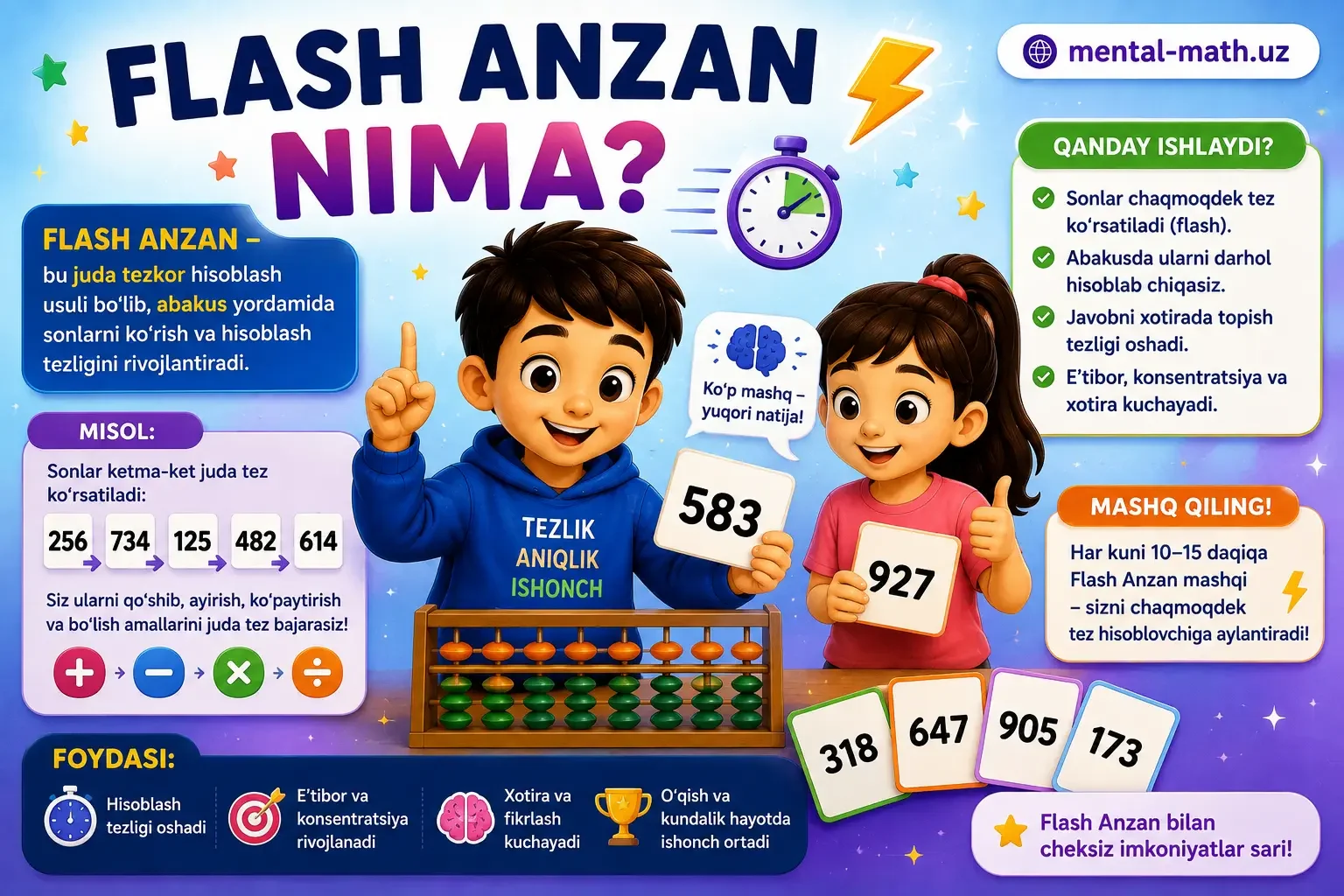
The most famous mental arithmetic videos all look the same: numbers flash on a screen for fractions of a second and a child announces the total the moment they stop. This is flash anzan. The Japanese word "anzan" means mental calculation; "flash" refers to the way the numbers are shown.
From the outside it looks like a miracle. In reality it is the last link in a strict sequence — which is exactly why starting it early hurts rather than helps.
The mental abacus: how it works
The secret of flash anzan is not hearing the numbers or repeating them. An experienced child sees an image of the abacus in their head and moves the beads mentally. They are not thinking "seven plus eight" — they are watching beads move on a rod.
That difference matters. Verbal calculation uses the language areas of the brain, which are slow and narrow: just as you cannot speak two sentences at once, you cannot "say" two numbers at once. Visuospatial imagery runs in parallel — hence the speed. Brain-imaging studies report that in abacus-trained children the visuospatial regions are more active during calculation.
Why this has to be the last stage
The mental abacus works on one condition: the hand movements must be automatic. If a child cannot perform the small friends and big friends formulas without thinking, there is no mental "room" left for moving beads — all the attention goes into recalling the rule.
The practical criterion is simple: if the child can add ten single-digit numbers on a real abacus quickly and without errors, they are ready for flash anzan. That usually happens 6-12 months after starting.
Records: where is the ceiling?
Japan holds official flash anzan competitions and the results are startling: the strongest competitors add fifteen three-digit numbers in under two seconds. Reaching that level takes years of daily training — a narrow specialisation comparable to professional sport.
An important reminder for parents: the goal is not a record. For an ordinary child, the value of flash anzan lies elsewhere — it builds sustained attention, working memory capacity and the ability to work with mental images. Those benefits arrive in full at five numbers per second too.
How to train
1. Start with the count of numbers, not the speed. Begin with 3 numbers at a slow pace (say, one every 2 seconds). Increase the count only once answers are consistently correct.
2. Shorten the interval gradually. 2 seconds → 1.5 → 1 → 0.7. Stay at each step for at least a few days.
3. Never raise both parameters at once. Either the count or the speed — pushing both together produces errors and destroys confidence.
4. Five to ten minutes a day is enough. Flash anzan is a very dense load: after ten minutes attention drops naturally and continuing serves no purpose.
5. Do not skip the bead mode. Flashing abacus beads instead of digits strengthens the mental image considerably — especially useful during the transition period.
Common mistakes
Moving fingers in the air. At first this is normal and even helpful — the child reinforces the image with movement. After a few months, though, the habit should be phased out, or speed will plateau there.
Saying the numbers out loud. That is a return to the verbal channel — precisely what flash anzan exists to avoid. Remind the child: "don't say it, see it".
Attempting a record every day. Constant training at maximum speed is exhausting and cements errors. Most of a session should run at a pace the child handles comfortably.
Flash mode in MentalMath
On the platform, flash mode runs in two forms — digits or abacus beads — and the pace adapts automatically to the child's results. Once the formulas are solid, moving from the abacus lesson to flash exercises is a natural next step. For the full roadmap of the method, read What is mental arithmetic?