
The MentalMath blog
A collection of useful articles on mental arithmetic, memory training, brain games and child development. Practical tips for parents and teachers.

Poor first-term grades: what parents should do next
First-term grades came back lower than expected, especially in math. Instead of panic or punishment: how to find the real cause, what to ask the teacher and a calm plan for next term.

Careless Mistakes in Math: When a Child Knows the Material but Still Gets It Wrong
Your child understands the topic, yet on the test swaps + for − or copies a number wrong? That is not a knowledge gap but an attention issue — and calm, simple habits can change it.

Mental Math Speed by Grade: Rough Benchmarks, a Home Test and Daily Drills
Is your child behind classmates in mental math, or right on track? Rough benchmarks for grades 1–6, a two-minute test you can run at home and a 10-minute daily drill for speed.

Preparing for a Math Olympiad: An 8-Week Plan for Primary School Children
Olympiad problems are nothing like a regular test: they check logic, pattern spotting and creative thinking. Here is how to prepare a child in grades 2-4 in six to eight weeks.

Homework Without Arguments: A Six-Step Routine
A concrete six-step homework routine that ends the nightly battle: fixed time and place, a short warm-up, timed blocks, the parent's role, subject order and a proper finish.

Starting First Grade: What Parents Should Watch in the First Month
Your child has just started first grade. Which signs of tiredness are normal in month one, which are warning signs, how to help without pressure, and when to talk to the teacher.

A school child's daily routine: balancing lessons, practice, rest and sleep
A realistic daily routine for a school-age child: an hour-by-hour template, how a first-grader differs from a fourth-grader, sleep needs by age, and where short daily practice fits.

School Has Started: How to Add Mental Arithmetic Without Overloading Your Child
School is back and your child is already busy. Can mental arithmetic fit on top? The honest answer: 15 minutes a day is enough, but now is not always the right time to start.
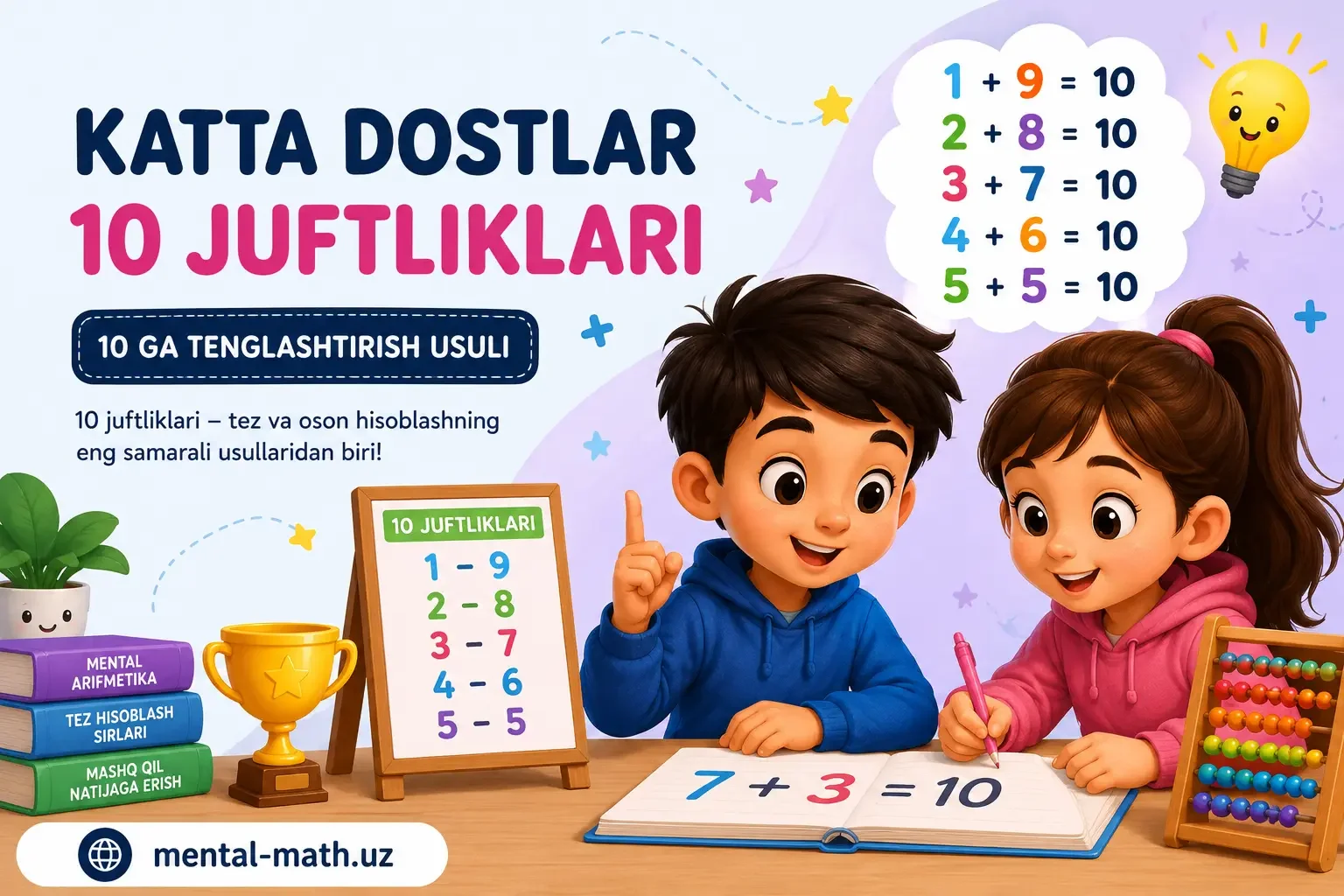
Big Friends (Pairs of 10): How Crossing the Ten Works
The most-used formula in mental arithmetic: big friends. Pairs 1-9, 2-8, 3-7, 4-6, 5-5, the crossing-the-ten rule and combined formulas, all with worked examples.